




Conversion rate optimisation is the fastest way for Australian businesses to grow revenue without spending an extra dollar on traffic. Most websites already get visitors the real problem is that too few of them turn into enquiries, sign-ups, or sales. CRO is the structured process of finding out why visitors leave without converting, then systematically fixing it.
This guide walks through a practical CRO framework, the highest-impact fixes for Australian websites, and how to measure results properly, whether you run an eCommerce store, a services business, or a lead-generation site.
What Is Conversion Rate Optimisation?
Conversion rate optimisation (CRO) is the practice of increasing the percentage of website visitors who complete a desired action a purchase, a form submission, a phone call, or a booking without needing to increase traffic. Conversion rate is calculated simply: (Conversions ÷ Total Visitors) × 100. A site getting 10,000 visitors a month with 100 conversions has a 1% conversion rate; lifting that to 2% doubles revenue from the exact same traffic.
CRO sits alongside SEO and paid advertising as one of the three core digital marketing levers, but it is consistently the most underused most businesses spend heavily on traffic while ignoring what happens once people actually land on the page.
Why CRO Matters More Than More Traffic
- Improves ROI on existing SEO and Google Ads spend instead of requiring a bigger budget
- Reduces cost per acquisition (CPA) across every paid channel simultaneously
- Surfaces real usability issues slow pages, confusing forms, unclear pricing that also hurt SEO rankings
- Compounds over time: small percentage gains stack month after month
Many businesses invest in traffic-side services such as SEO or Google Ads campaigns before ever auditing their own site’s conversion path which means a large share of that paid traffic is arriving on a page that was never built to convert it.
CRO Strategy Framework: A 5-Step Process
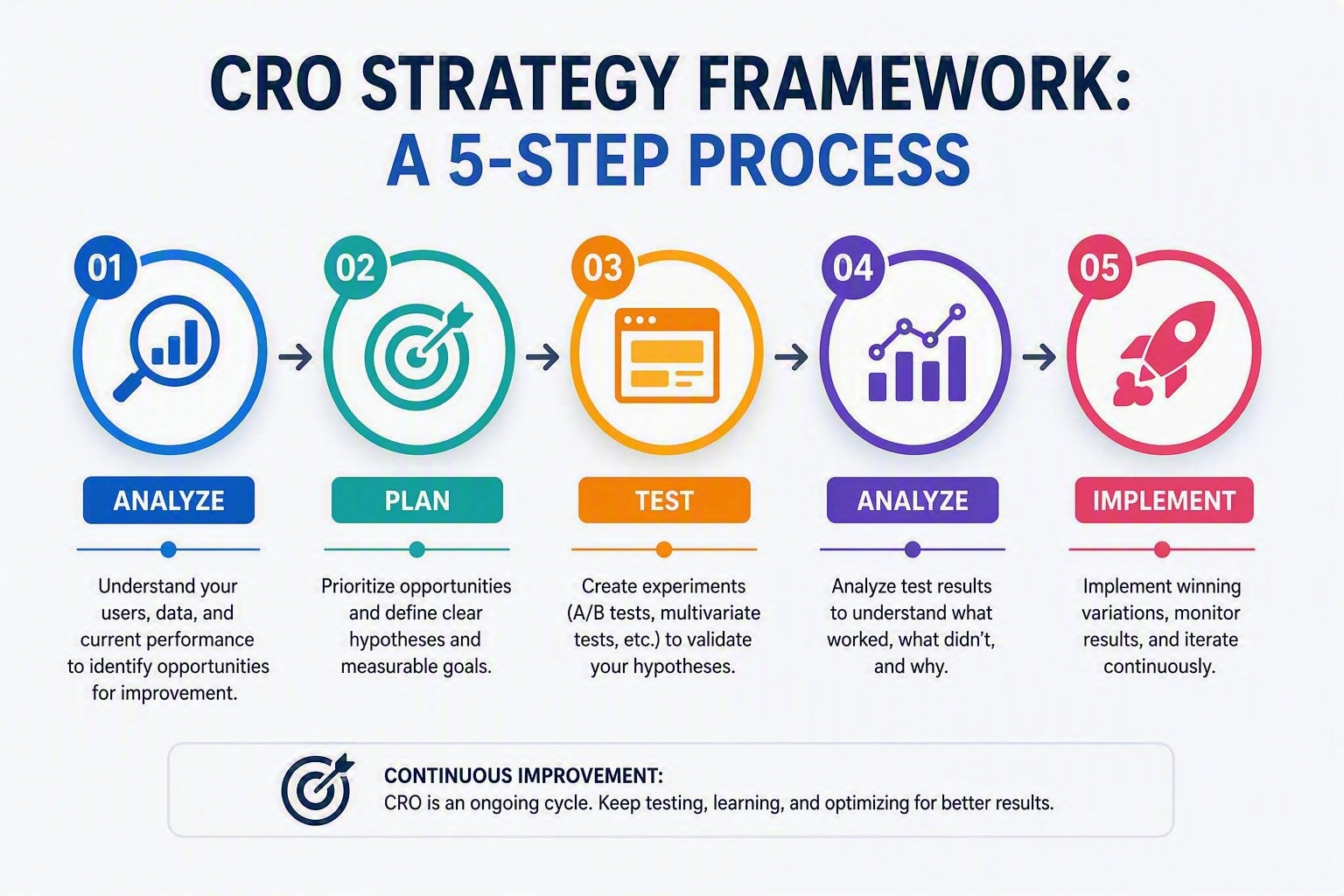
| Step | What Happens |
| 1. Research | Analyse Google Analytics, heatmaps (Hotjar/Clarity), and session recordings to find drop-off points |
| 2. Hypothesis | Form a specific, testable theory for why visitors aren’t converting at that point |
| 3. Prioritise | Rank fixes by potential impact vs effort (PIE or ICE scoring) |
| 4. Test | Run A/B or multivariate tests on the highest-priority changes |
| 5. Analyse & Roll Out | Measure statistically significant results, roll out winners, repeat the cycle |
CRO Checklist: High-Impact Fixes
- Clear, single call-to-action above the fold (avoid competing buttons)
- Trust signals near the CTA — reviews, testimonials, security badges, guarantees
- Shorter forms — every extra field measurably reduces completion rate
- Fast mobile page speed — over half of Australian traffic is mobile
- Clear, upfront pricing instead of “contact us for a quote” where possible
- Live chat or click-to-call for high-intent service pages
- Exit-intent offers for eCommerce cart abandonment
CRO by Business Type
eCommerce Conversion Rate Optimisation
Average Australian eCommerce conversion rates sit between 1–3%, with cart abandonment often above 65%. The highest-impact eCommerce CRO fixes are simplifying checkout to as few steps as possible, offering guest checkout, and showing shipping costs early. This ties directly into the eCommerce marketing budget a business allocates each month CRO improvements make that same budget go further.
Lead Generation & Services CRO
For services businesses (trades, professional services, B2B), the biggest lever is usually reducing form friction and adding a phone number and click-to-call button prominently on every page, since a large share of high-intent traffic prefers to call rather than fill out a form.
Measuring CRO Success
CRO only works when it is measured properly. Recommended tracking setup:
- Goal/conversion tracking configured correctly in Google Analytics 4
- Google Ads and Google Analytics linked for accurate cost-per-conversion reporting
- Heatmap and scroll-depth tracking on key landing pages
- A/B test statistical significance checked before declaring a winner (95% confidence minimum)
Google’s own Analytics conversion tracking documentation is the authoritative reference for setting this up correctly before running any CRO test.
Conversion Rate Optimisation Services Across Australian Cities
Demand for structured CRO services continues to rise across Australia’s major markets, particularly among eCommerce and lead-generation businesses:
| City | CRO Demand Driver |
| Sydney | Competitive eCommerce and SaaS businesses optimising high-value paid traffic |
| Melbourne | Retail and professional services firms testing landing pages against Google Ads spend |
| Brisbane | Growing local service businesses improving lead-form conversion rates |
| Perth | Trades and home services businesses optimising click-to-call conversion paths |
| Adelaide | Small-to-medium retailers improving checkout completion rates |
| Canberra | Professional and government-adjacent service providers refining enquiry funnels |
Working With a CRO Agency
A dedicated CRO agency brings analytics tooling, testing frameworks, and design resource that most in-house teams don’t have time to build. If your business is comparing traffic-generation spend against conversion improvements, our guide on Google Ads costs in Australia is a useful companion read CRO work typically pays for itself many times over by improving what that same ad spend converts into.
For Brisbane-based businesses specifically, see our related pricing breakdown on digital marketing agency costs in Brisbane, which covers CRO as part of a broader monthly retainer.
Teams wanting to build CRO and analytics skills internally can also explore Logitrain digital marketing and analytics training for upcoming Australian course dates.
Frequently Asked Questions
What is a good conversion rate for a website?
It varies heavily by industry: eCommerce typically sits between 1–3%, lead-generation service sites between 2–5%, and SaaS free-trial sign-ups can run higher. The right benchmark is your own historical rate, improved over time.
How long does a CRO test need to run?
Most A/B tests need at least 2–4 weeks and enough traffic to reach statistical significance (typically several hundred conversions per variant) before results can be trusted.
Is CRO better than SEO or Google Ads?
CRO isn’t a replacement for SEO or Google Ads it multiplies the value of both by converting more of the traffic those channels already generate.
Conclusion
Conversion rate optimisation is one of the highest-ROI activities available to Australian businesses because it improves results from traffic you’re already paying for or already ranking for. A structured, test-driven CRO process research, hypothesis, prioritise, test, analyse consistently outperforms one-off redesigns.
Want a CRO audit for your website? Get in touch via digitalmarketingagencies.au or explore related training on logitrain.com.au.