





Creative fatigue is the quiet tax on every ad that works. You launch a campaign, the numbers look fantastic, and for a few weeks it feels like you have cracked the code. Then the cost per lead creeps up, the click-through rate slides, and the same ad that made you look clever starts costing twice as much to deliver the same result.
Nothing is broken. Your targeting is still fine, your offer is still good, and your budget has not changed. What changed is that people have seen your ad too many times, and the ad platforms have noticed. This guide explains why successful ads become more expensive over time, how to spot creative fatigue early, what it really costs, and a practical system for beating it. It is written for Australian business owners, in-house marketers and anyone managing Google Ads or Meta Ads budgets.
What Is Creative Fatigue and Why Call It a Tax?
Creative fatigue happens when an audience gets tired of seeing the same ad, image, video or headline, and responds less each time. Marketers also call it ad fatigue or ad wearout. The ad itself does not get worse. The audience simply gets used to it, and a familiar message stops earning attention.
We call it a tax because you pay it automatically, without choosing to. Every winning ad carries a hidden cost that grows with success: the more you spend on it, the faster it burns out. You cannot avoid the tax, but you can plan for it, and the businesses that plan for it keep their cost per acquisition steady while everyone else wonders why results keep sliding.
Why Successful Ads Become More Expensive Over Time
Several things happen at once, and they compound. Understanding each one helps you decide where to act.
1. Your best prospects convert first
A new ad reaches the people most likely to respond. They click, enrol or buy early. Once that warm pocket of demand is used up, the ad is shown to colder people who need more convincing. The creative has not changed, but the audience quality has, so conversion rates fall and cost per result rises.
2. Frequency climbs and attention drops
Frequency is the average number of times one person sees your ad. In a small or tightly targeted audience, it rises fast. By the fifth or sixth exposure, many people scroll past without reading a word, and a few start hiding or reporting the ad.
3. Lower engagement raises your effective cost
Ad auctions do not only reward the highest bid. Platforms such as Meta and Google also weigh how likely people are to engage with your ad. When click-through rate and engagement fall, your ad becomes less competitive, so you pay more to win the same impressions. That is the creative fatigue tax showing up directly in your CPM and CPC.
4. The algorithm runs out of fresh signals
Automated bidding and delivery systems learn from new behaviour. A stale ad produces fewer fresh positive signals, so the system has less to optimise with. Performance becomes flatter and more expensive even when you leave every setting untouched.
5. Competitors and seasons move the goalposts
Your rivals launch new creative, a sale period pushes auction prices up, and your once-original angle starts to look like everyone else’s. Fatigue is partly internal, because your audience has seen you, and partly external, because the market around you keeps moving.
| Ad life stage | What you usually see | Effect on cost |
| Launch (weeks 1 to 2) | High CTR, low frequency, strong conversion rate | Lowest CPA, often the “hero” numbers you report |
| Scale (weeks 3 to 4) | Spend rises, frequency starts climbing | CPA holds, then begins to drift up |
| Plateau | CTR flattens, conversion rate softens | CPM and CPC rise, CPA clearly worse |
| Creative fatigue | CTR drops sharply, frequency high, negative feedback rises | CPA can be double the launch level, ROAS shrinks |
Signs of Creative Fatigue in Your Ad Account
Waiting until the monthly report is too slow. Check these signals weekly, and compare each ad with its own first week rather than with a generic benchmark, because healthy numbers vary by industry and platform.
| Metric | Warning sign | Where to check |
| Frequency | Steadily rising, especially past the level where results started to dip | Meta Ads Manager; Google Ads reach and frequency reports for video and Demand Gen |
| Click-through rate (CTR) | Down by a quarter or more against the first week | Ads Manager or Google Ads campaign and asset views |
| CPM and CPC | Climbing while targeting and budget stay the same | Account-level cost columns |
| Hook rate (3-second views divided by impressions) | Falling, which means the opening is no longer stopping the scroll | Video metrics in Meta or TikTok Ads |
| Conversion rate and CPA | Conversion rate down, cost per acquisition up | Google Analytics 4 and platform conversion reporting |
| Comments and feedback | More “I keep seeing this” comments, more hides | Ad comments, negative feedback score |
One signal alone is not proof. Two or three moving the wrong way together, over several days, is a strong sign you are paying the creative fatigue tax.
Creative Fatigue on Meta, Google Ads, TikTok and YouTube
Creative fatigue on Meta Ads
Meta feeds and Reels are the classic home of ad fatigue, because the same people scroll daily and your ad sits in front of them again and again. Watch frequency and CTR inside Ads Manager, and give the delivery system a mix of formats and angles instead of one image. The Meta Business Help Centre explains the auction and delivery basics in plain language.
Creative fatigue in Google Ads
Search ads fatigue more slowly, but they still wear out. Responsive search ads that run the same headlines for a year lose click-through rate as competitors improve. Performance Max and Demand Gen campaigns depend heavily on fresh images, videos and text, so thin asset groups go stale quickly. Review asset performance regularly and replace the weakest assets first. The official Google Ads Help pages cover asset reporting in detail.
Creative fatigue on TikTok and YouTube
Short video moves fastest of all. A hook that works this month can feel old next month, so these channels need a steady flow of new openings, creators and formats. Think with Google regularly publishes research on how audiences respond to video ads.
How Much Does Creative Fatigue Really Cost?
Here is a simple, illustrative example in Australian dollars. It is not a benchmark, just the arithmetic of how small drops compound.
| Metric | Week 1 (fresh ad) | Week 6 (fatigued ad) |
| CPM (cost per 1,000 impressions) | $20.00 | $26.00 |
| Click-through rate | 1.8% | 1.1% |
| Cost per click | $1.11 | $2.36 |
| Conversion rate | 3% | 3% |
| Cost per acquisition | $37.04 | $78.79 |
Notice that the conversion rate stayed exactly the same. A modest rise in CPM and a fall in click-through rate alone more than doubled the cost of each customer. On a $5,000 monthly budget, that is the difference between roughly 135 customers and roughly 63. That gap is the creative fatigue tax, and it is invisible unless you track it.
How to Fix Creative Fatigue: A 6-Step Refresh System

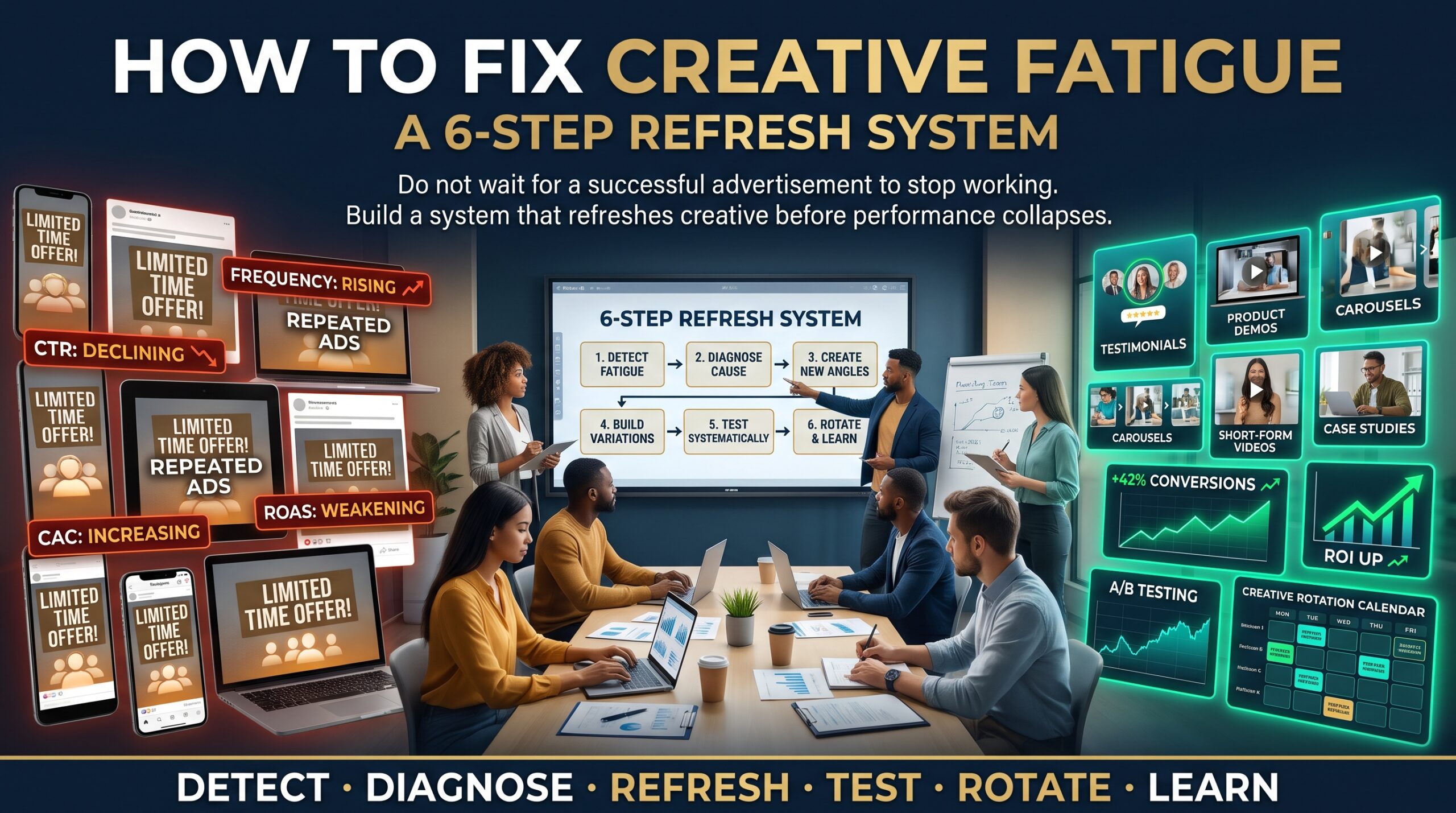
- Set a refresh rhythm. Decide in advance how often each campaign gets new creative. High-spend social campaigns may need fresh ads every few weeks, while search assets can usually be reviewed monthly or quarterly.
- Change the idea, not just the colour. Swapping a button colour is a variation. A new angle, such as price, proof, a customer story or a common objection, is a new concept. Platforms and audiences respond to new concepts.
- Test hooks first. The first three seconds of a video and the first line of a headline decide almost everything. Produce several openings for the same core message and let the data pick the winner.
- Mix formats. Rotate static images, short video, carousels, user-generated style content and text-led ads. Different people respond to different formats, and the mix slows down wearout.
- Refresh audiences and exclusions. Exclude recent buyers and engaged users, widen the audience where it makes sense, and add new lookalike or interest groups so frequency does not spiral in a small pool.
- Use clear rules for retiring ads. Agree in writing that an ad is paused when frequency passes a set level and CTR is down by a set percentage. Rules remove the emotion from killing an ad that used to win.
How to Prevent Creative Fatigue Before It Starts
The cheapest way to beat creative fatigue is to never depend on one ad. Build a creative backlog so the next concept is always ready before the current one fades. Keep a small, permanent testing budget, commonly in the range of 10 to 20 percent of spend, for new ideas. Name your ads consistently so you can see which angle, format and hook produced each result. And when you refresh, keep every claim accurate and compliant, because new wording still has to meet the ACCC advertising and promotions guidance.
- Document the winning angle so you can rebuild it in new formats
- Rotate seasonal and event-based creative to match what customers care about now
- Review the account weekly, not monthly
- Keep tracking clean with the pixel, Conversions API and Google Analytics 4 so you can trust the cost data
Creative Fatigue by City: What Australian Advertisers Should Watch
Audience size decides how quickly fatigue arrives. A smaller metro audience saturates sooner, while a large one gives you more room but more competition. Here is how it tends to play out across major markets, with the local service page for each.
| City | Fatigue pressure | Local agency page |
| Sydney | Heavy competition and high auction prices, so wasted impressions are expensive | Digital marketing agency Sydney |
| Melbourne | Large audiences but crowded retail and eCommerce categories, so creative has to stand out | Digital marketing agency Melbourne |
| Brisbane | Fast-growing market where new entrants keep raising competition | Digital marketing agency Brisbane |
| Perth | Smaller audience pool, so frequency climbs quickly and refresh cycles must be shorter | Digital marketing agency Perth |
| Adelaide | Compact metro audience that saturates fast on social platforms | Digital marketing agency Adelaide |
| Canberra | Narrow professional and government audiences that tire of repeated messages | Digital marketing agency Canberra |
Services That Help You Beat Creative Fatigue
Fixing creative fatigue is easier with a team that produces fresh ads on a schedule. At Digital Marketing Agencies we combine Google Ads management, digital advertising, social media marketing and content marketing so your creative pipeline never runs dry. If you sell online, our eCommerce marketing service builds product-led creative around your best sellers, and our SEO services bring in organic traffic that does not suffer from ad wearout at all.
Prefer predictable costs? See our Google Ads packages, digital advertising packages and social media marketing packages, or browse every service and package we offer.
Learn to Manage Ad Performance Yourself
If you would rather build the skills in-house, Logitrain runs practical training for marketers. Explore the digital marketing course or the digital marketing job program to learn campaign setup, testing and reporting hands on. Understanding how ads age makes you a far better buyer of agency services too.
Frequently Asked Questions About Creative Fatigue
What is creative fatigue in advertising?
Creative fatigue is the drop in ad performance that happens when your audience sees the same creative too often. Click-through rate falls, frequency rises, and cost per result climbs even though your targeting and budget have not changed.
How often should I refresh my ad creative?
There is no universal number. High-spend social campaigns often need new creative every two to four weeks, while search ad copy can be reviewed monthly or quarterly. Let frequency, CTR and CPA trends tell you, and refresh before the numbers collapse.
Why is my cost per acquisition rising when the ad used to perform well?
The most common reason is creative fatigue. Your best prospects have already converted, frequency has built up, and lower engagement is making the ad more expensive in the auction. Check frequency and CTR against week one before changing anything else.
Does Google Ads have creative fatigue too?
Yes, though it usually arrives more slowly than on social platforms. Responsive search ads, Performance Max asset groups and Demand Gen creative all lose impact when they are not refreshed, so review asset performance on a regular schedule.
Can a digital marketing agency fix creative fatigue?
A good agency monitors fatigue signals weekly, keeps a pipeline of new concepts ready, and retires tired ads using clear rules. That removes the guesswork and protects your cost per acquisition as you scale.
Stop Paying the Creative Fatigue Tax
Success is exactly what makes an ad expensive, so the answer is not to stop winning. It is to keep a steady supply of fresh ideas behind every winner. Track the warning signs, refresh on a rhythm and test new angles before the old ones fade, and creative fatigue becomes a manageable cost instead of a mystery. Want a second pair of eyes on your account? Contact our team or call 1300 649 299 for a free consultation, and see our about page to meet the people behind the work.