
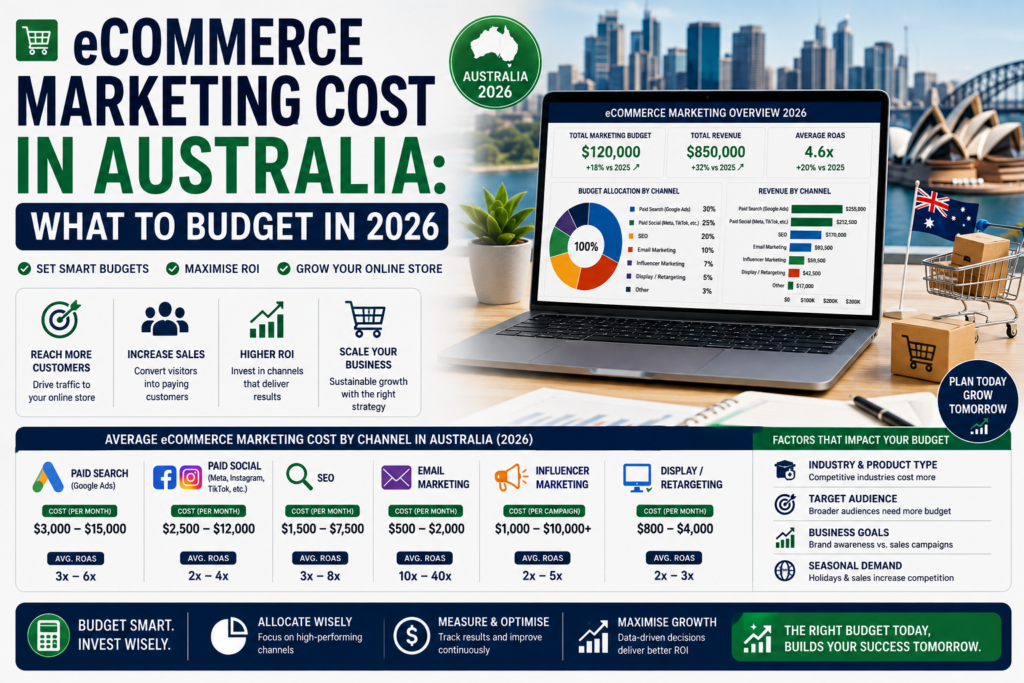

Understanding eCommerce marketing cost in Australia is the first step before you commit a single dollar to Google Ads, SEO, or social media in 2026. Online store owners in Sydney, Melbourne, Brisbane, Perth, and Adelaide are all asking the same question: how much should an eCommerce brand realistically spend on marketing, and where should that budget go first? This guide breaks the eCommerce marketing cost down channel by channel, with real Australian pricing ranges, so you can plan a 2026 budget with confidence.
If you’d rather have a strategist build this plan with you, Digital marketing agency services can put together a channel mix tailored to your store’s revenue and margins.
What Drives eCommerce Marketing Cost in Australia?
Your eCommerce marketing cost depends on store size, average order value, competition in your product category, and how many channels you run at once. A boutique Shopify store selling accessories has a very different cost structure to a national fashion retailer competing on paid search in Sydney and Melbourne. As a general rule, most Australian eCommerce brands should plan to spend 7–15% of online revenue on marketing, higher again for newer stores still building brand awareness.
2026 eCommerce Marketing Cost by Channel
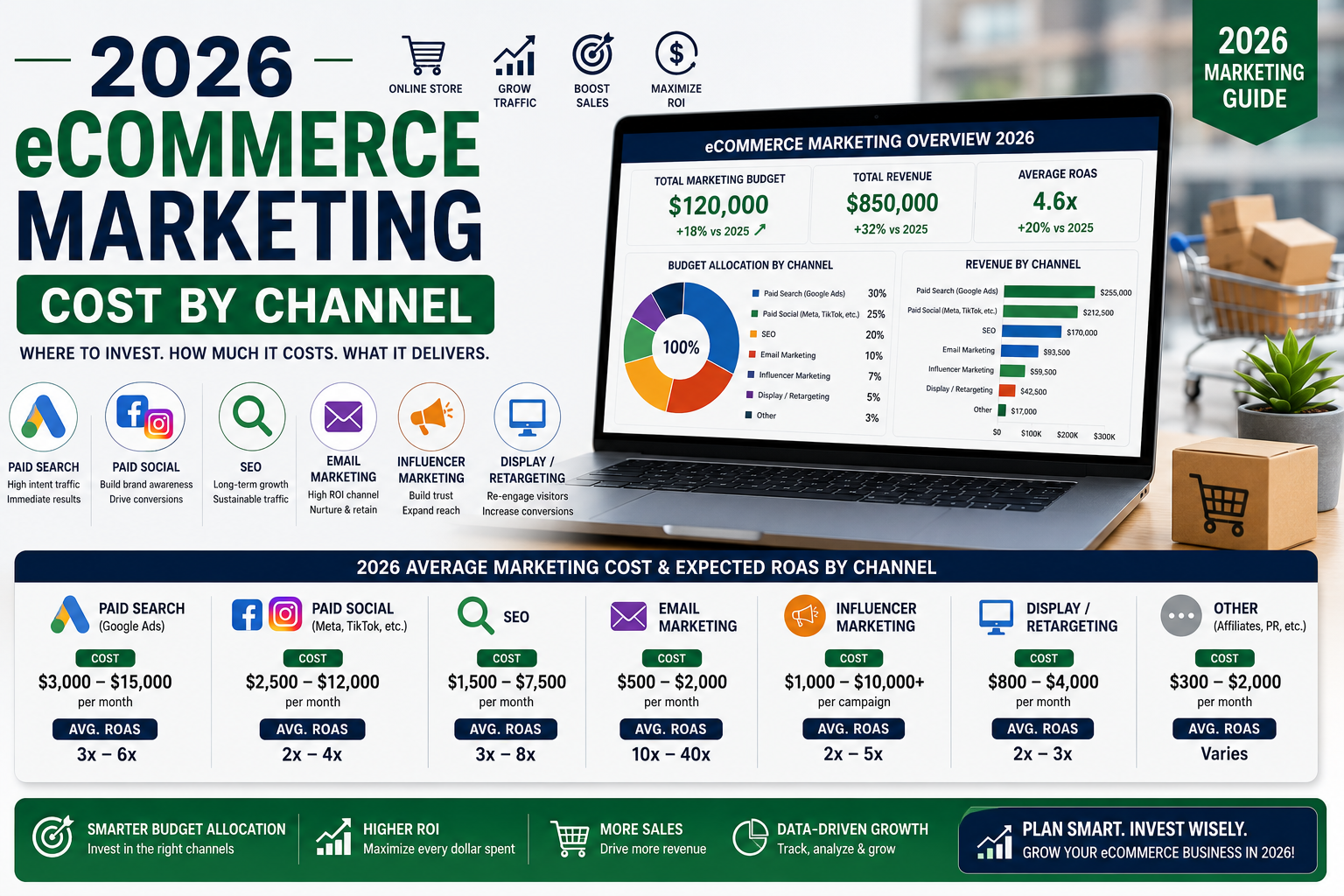
Here is a realistic monthly eCommerce marketing cost breakdown for a small-to-mid-size Australian online store in 2026:
| Channel | Small Store | Growing Store | Established Brand |
|---|---|---|---|
| Google Ads (Shopping + Search) | $1,500 – $3,000 | $4,000 – $8,000 | $10,000+ |
| Meta Ads (Facebook/Instagram) | $1,000 – $2,500 | $3,000 – $7,000 | $8,000+ |
| SEO (agency retainer) | $800 – $1,800 | $2,000 – $4,000 | $4,500+ |
| Email/SMS Marketing | $300 – $700 | $800 – $1,800 | $2,000+ |
| Content & Creative | $500 – $1,200 | $1,500 – $3,000 | $3,500+ |
| Influencer/Affiliate | $0 – $1,000 | $1,000 – $3,000 | $4,000+ |
These figures align with the broader digital ad spend trends reported by IAB Australia and retail benchmarks from the Australian Bureau of Statistics. Treat them as a starting range — your exact eCommerce marketing cost will shift based on category competitiveness and current conversion rate.
Google Ads Cost for eCommerce Stores
Google Shopping and Search campaigns typically make up the largest share of eCommerce marketing cost for Australian retailers because they capture high-intent buyers. Average CPCs range from $0.50–$1.50 for lower-competition categories up to $3–$6+ for competitive verticals like fashion, beauty, and electronics in Sydney and Melbourne markets. Budget at least $1,500/month to gather enough data for the algorithm to optimise properly.
SEO Cost for eCommerce Websites
SEO is typically the best long-term value component of eCommerce marketing cost because it compounds rather than switching off the moment you stop paying. Australian agencies charge anywhere from $800/month for a lean product-page optimisation retainer up to $4,500+/month for full technical SEO, content, and link-building programs across a large catalogue site.
Social Media & Influencer Marketing Cost
Meta and TikTok ad spend for eCommerce brands in Australia usually mirrors or slightly undercuts Google Ads budgets, while influencer and affiliate costs vary hugely from product gifting only, up to $5,000+ campaigns with mid-tier Australian creators in Sydney, Melbourne, and Brisbane.
eCommerce Marketing Cost by Australian City
Agency fees and paid media competition both shift depending on where your business and target customers are based:
- Sydney — highest competition and CPCs; expect premium agency retainers and higher Google/Meta ad costs.
- Melbourne — close behind Sydney, strong fashion and lifestyle eCommerce competition.
- Brisbane — moderate costs, growing eCommerce agency market; see
- Perth — lower competition in several categories, often a more cost-efficient testing ground.
- Adelaide — generally the most budget-friendly major market for early-stage eCommerce testing.
How to Build Your 2026 eCommerce Marketing Budget
- Start from target revenue, not available cash work backwards from your revenue goal using your current conversion rate and average order value.
- Allocate 40–50% of budget to paid search/shopping if you’re an established store with existing demand.
- Allocate a growing share to SEO and email/SMS, since these lower your cost per acquisition over time as they mature.
- Set a testing budget (10–15%) for new channels like TikTok Shop or affiliate partnerships.
- Track cost per acquisition (CPA) and marketing efficiency ratio (MER) monthly, not just total spend.
- Review agency or freelancer fees against deliverables every quarter don’t set and forget your eCommerce marketing cost.
Need a second opinion on your current spend?
Digital marketing services covers SEO, Google Ads, and paid social under one roof, and Logitrain digital marketing training courses is available if you’d rather build in-house capability instead of outsourcing entirely.
Frequently Asked Questions
What is a reasonable eCommerce marketing cost as a percentage of revenue?
Most established Australian eCommerce brands spend 7–15% of revenue on marketing, while newer stores building brand awareness often spend 15–25% in their first 12–18 months.
Is SEO or Google Ads a better first investment for a new store?
Google Ads generates faster, more predictable traffic while your SEO foundation is being built, so most agencies recommend running both in parallel rather than choosing one exclusively.
Do agency fees vary much between Australian cities?
Yes — Sydney and Melbourne agencies typically charge a premium over Brisbane, Perth, and Adelaide agencies for comparable scopes of work, though remote/online delivery has narrowed this gap in recent years.