
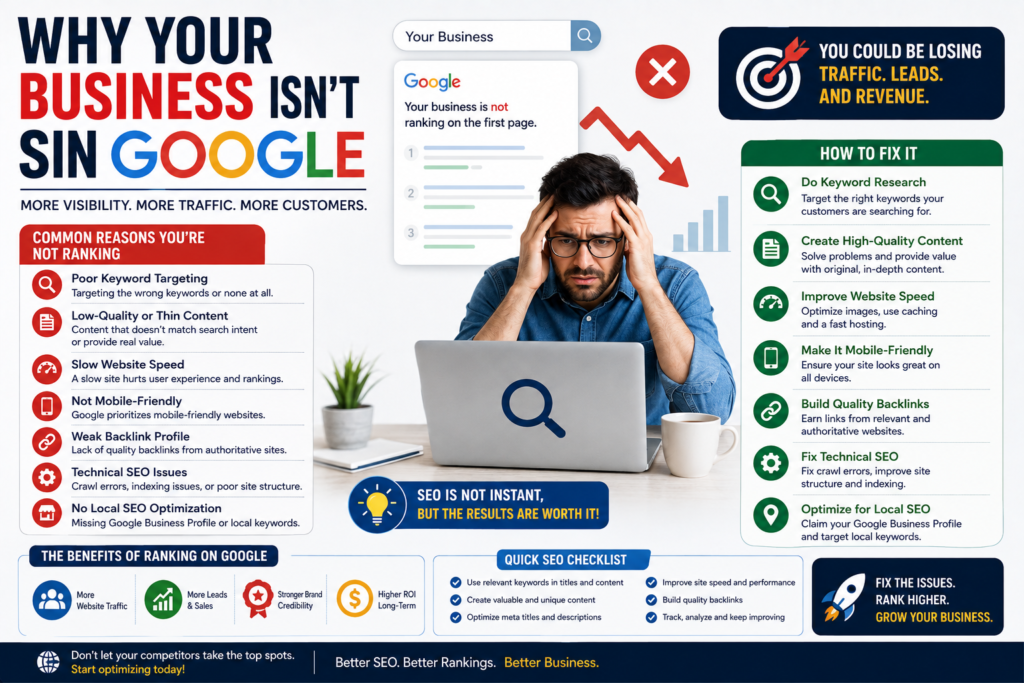

If you’ve been asking why your business isn’t ranking on Google despite publishing blog posts, running ads, and staying active on social media, you’re not alone and it’s rarely one big problem. In 2026, Google’s algorithms evaluate content quality, technical performance, search intent, and topical authority together, which means most businesses lose rankings to a stack of small, fixable mistakes rather than one obvious error.
Looking for professional SEO support? We help businesses in Sydney, Melbourne, Brisbane, Perth, Adelaide, Canberra, Gold Coast, Hobart, Darwin, and across Australia improve their Google rankings and organic visibility. Call our digital marketing team on tel:1800 159 151 to discuss the right SEO strategy for your business.
Quick Reference: 12 SEO Mistakes and Fixes
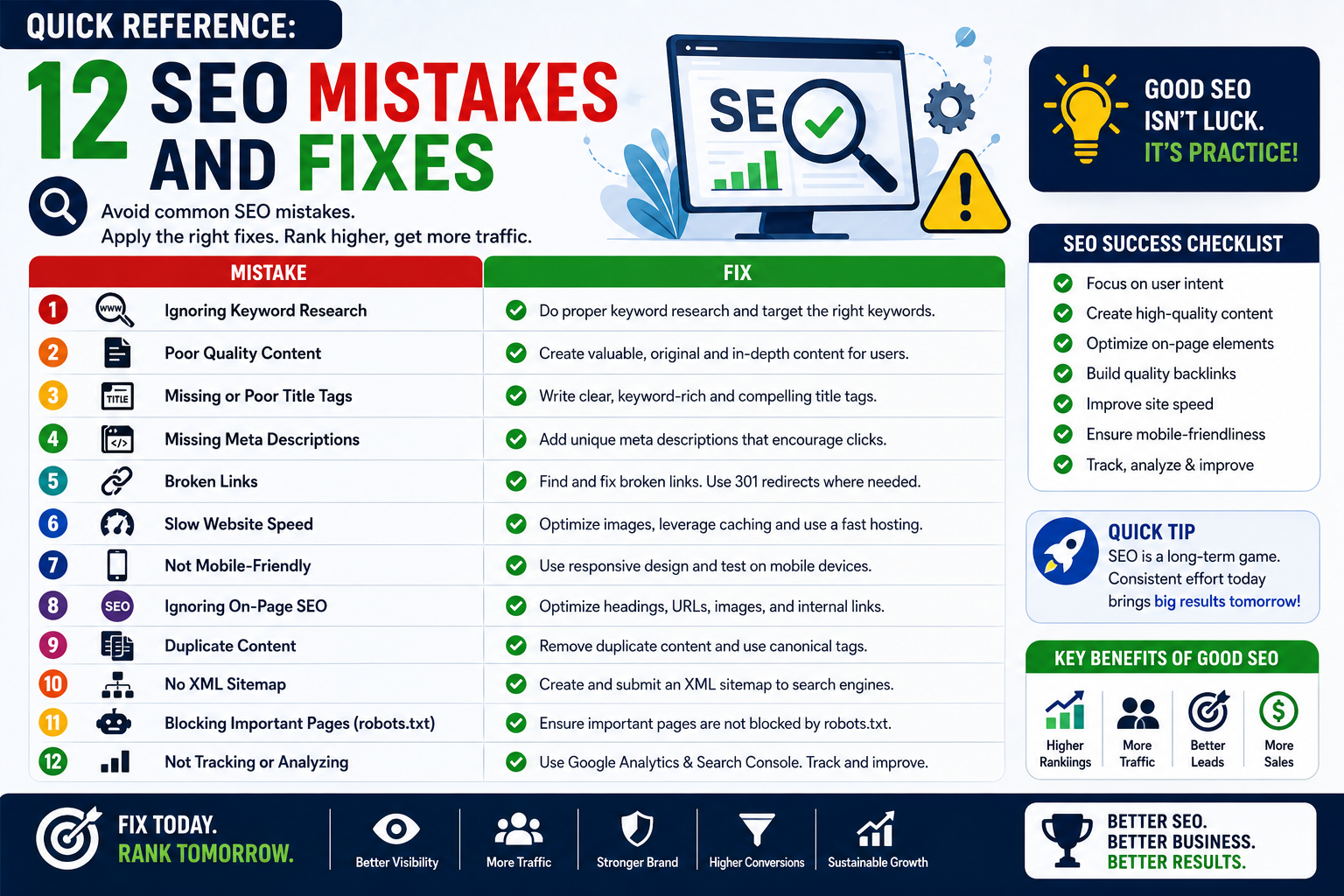
| # | SEO Mistake | Quick Fix |
| 1 | No Google Business Profile optimisation | Claim, verify and fully complete your GBP listing |
| 2 | Targeting the wrong (too broad) keywords | Shift to specific, high-intent, local keywords |
| 3 | Ignoring search intent | Match content type to what the searcher actually wants |
| 4 | Slow-loading, non-mobile-friendly website | Compress images, use responsive design, test speed |
| 5 | Thin or outdated content | Rewrite pages under 500 words; refresh old statistics |
| 6 | Missing title tags & meta descriptions | Write unique, keyword-front-loaded titles for every page |
| 7 | No internal linking strategy | Link related pages together with descriptive anchor text |
| 8 | No backlinks / low-quality backlinks | Earn links through content, partnerships and outreach |
| 9 | Poor technical SEO (broken links, no sitemap) | Run regular audits with Search Console & PageSpeed Insights |
| 10 | No schema markup | Add structured data for business, services, and reviews |
| 11 | Ignoring local SEO signals | Build local citations, location pages, and reviews |
| 12 | Not tracking rankings, traffic or conversions | Set up Search Console and Analytics goal tracking |
1. Your Google Business Profile Is Incomplete or Unclaimed
If your business serves a specific area, an unclaimed or half-finished Google Business Profile is one of the fastest ways to disappear from local search and Google Maps. Missing categories, no service list, and inconsistent NAP (name, address, phone) details all make it harder for Google to understand and trust your listing. See Google’s official Business Profile guidelines for the current setup requirements.
Fix: Claim and fully verify your profile, choose the most accurate business category, list every service explicitly, and keep your business details identical across your website, directories, and social profiles.
2. You’re Targeting the Wrong Keywords
A common reason why your business isn’t ranking on Google is chasing broad, high-competition terms your site has no realistic chance of winning yet, while ignoring the specific, high-intent phrases your actual customers are searching for. Competing directly with national brands for a generic term is rarely a fair fight for a small or mid-sized business.
Fix: Shift toward long-tail, locally specific, and high-intent keywords – phrases that match exactly what a ready-to-buy customer would type into Google.
3. Your Content Doesn’t Match Search Intent
Ranking for a keyword means nothing if the page doesn’t satisfy why someone searched it. Google’s systems in 2026 are significantly better at detecting intent mismatches – if a searcher wants a local service provider and your page reads like a generic explainer, it won’t hold its position even if it briefly ranks.
Fix: Before writing or rewriting a page, ask what the searcher actually wants to do next – learn, compare, or buy – and build the page around that action.
4. Your Website Is Slow or Not Mobile-Friendly
Mobile traffic now accounts for more than 60% of all web searches, and Google indexes primarily using the mobile version of your site. A slow, unresponsive, or hard-to-navigate mobile experience quietly costs you both rankings and visitors before they ever read your content.
Fix: Compress images, use responsive design, and test regularly with Google’s PageSpeed Insights.
5. You’re Publishing Thin or Outdated Content
Publishing more content doesn’t automatically help – mass-producing shallow or generic pages just to hit a quota is one of the fastest ways to lose trust and visibility in 2026. Outdated statistics, broken links, and irrelevant references all signal to Google that a page isn’t being maintained.
Fix: Publish fewer, deeper pages that fully answer a specific question, and set a quarterly reminder to refresh your highest-traffic older content with current data.
6. Your Title Tags and Meta Descriptions Are Missing or Weak
Meta titles and descriptions remain essential click-through factors. A missing or generic meta description means you’re leaving click-through rate – and rankings that follow from it – on the table, even for pages that technically rank.
Fix: Write a unique, keyword-front-loaded title and a compelling one-to-two sentence meta description for every important page.
7. You Have No Internal Linking Strategy
Many sites rely solely on menu and footer navigation, leaving individual blog posts and service pages isolated from each other. Internal links help Google understand which pages matter most on your site and pass authority between related content.
Fix: Every new page should link to two or three related pages using natural, descriptive anchor text – not “click here.”
8. You Have No Backlinks (Or Low-Quality Ones)
Backlinks remain one of the strongest trust signals in Google’s algorithm, but quality matters far more than quantity in 2026. Buying low-quality links, using private blog networks, or getting links from unrelated niches can actively hurt rankings rather than help them.
Fix: Earn links through genuinely useful content, real partnerships, and direct outreach to relevant sites in your industry or region.
9. Your Technical SEO Foundation Is Broken
Even the best content underperforms if your site is technically weak – broken links, 404 errors, misconfigured sitemaps, and slow server responses all create friction for both users and crawlers. Use Google Search Console to identify indexing issues before they quietly drag down your rankings.
Fix: Run a technical audit at least quarterly, prioritise fixing crawl errors and broken links first, and confirm your XML sitemap only lists live, indexable pages.
10. You Haven’t Added Schema Markup
Structured data doesn’t guarantee rankings on its own, but it helps Google understand exactly what type of business, service, or content a page contains and it improves your chances of earning rich results in search.
Fix: Add schema markup for your business type, services, and customer reviews, and validate it before publishing to avoid errors that nullify the benefit.
11. You’re Ignoring Local SEO Signals
For businesses that serve specific cities or regions, ignoring local SEO is one of the costliest mistakes on this list. Customers actively searching for services “near me” or in a specific suburb won’t find you without location-specific content, consistent local citations, and a steady flow of reviews.
Fix: Build dedicated location pages for each city you serve, keep your business information consistent across every directory, and actively encourage customer reviews.
12. You’re Not Tracking Rankings, Traffic, or Conversions
Many businesses give up on SEO after a few months simply because they can’t see whether it’s working. Without tracking, it’s impossible to tell if a ranking drop is a real problem or normal fluctuation, or which pages are quietly losing traffic and need a refresh.
Fix: Set up Google Search Console and Analytics goal tracking, and review performance monthly rather than day to day, focused on trends, not single data points.
How to Fix These SEO Mistakes for Good
Working through all 12 of these issues at once can feel overwhelming, which is exactly why most businesses either stall out after fixing one or two, or hire an experienced team to run the full audit and fix systematically. The businesses that consistently rank on page one in 2026 treat SEO as an ongoing system technical health, content quality, and authority-building working together – not a one-off project.
If you’d rather have a specialist team handle this for you, digitalmarketingagencies.au runs full SEO services for Australian businesses, including technical audits, on-page optimisation, content strategy, and local SEO, alongside website design and SEO and Google Ads management for businesses that want paid and organic working together.
Where to Get SEO Help in Australia
Digital Marketing Agencies works with businesses across Australia, including Sydney, Melbourne, Brisbane, Perth, Adelaide, and Canberra, along with Gold Coast, Hobart, Darwin, Newcastle, Wollongong, Geelong, Sunshine Coast, Townsville, and Cairns. Browse the full range of services, check current SEO packages and pricing, or get in touch for a free consultation on why your business isn’t ranking on Google – and what to fix first.
Final Thoughts
There’s rarely a single reason why your business isn’t ranking on Google – it’s usually a combination of the 12 mistakes above compounding over time. The good news is that every one of them is fixable, and most businesses see meaningful movement within 60 to 90 days once technical issues are resolved, content is realigned to search intent, and local signals are strengthened. Start with the fixes that are cheapest and fastest to implement (meta tags, internal linking, Google Business Profile), then move into the deeper technical and content work.
Ready to find out exactly what’s holding your rankings back? Explore SEO services in Australia or book a free consultation to get a clear plan for your website.