


The credibility economy is the quiet shift changing how Australians decide who to buy from, and it is rewriting what every marketing dollar is worth. For years the playbook was simple: pay for attention, then hope some of it turned into sales. Today attention is cheap to rent and hard to keep, while trust is slow to earn and almost impossible to fake. If you run a business in Melbourne, Sydney, Brisbane, Perth, Adelaide or Canberra, the credibility economy is no longer a nice idea for the future. It is the reason some brands get searched by name while others get scrolled past.
In this guide we explain what the credibility economy actually is, why advertising alone is losing its punch, how Google rewards trustworthy businesses, and the practical steps you can take this quarter to build trust that compounds. Whether you run a local trade business, a clinic, an online store or a professional services firm, you will find something you can act on straight away.
What Is the Credibility Economy?
Put simply, the credibility economy is a marketplace where believability, not budget, decides who wins the customer. In a world where every brand can publish content, run ads and claim to be “the best”, people have learned to discount what companies say about themselves. They look for proof instead: real reviews, named experts, consistent behaviour, transparent pricing and evidence that a business does what it promises.
That does not mean marketing has stopped working. It means the signals customers trust have moved. A polished banner ad is a claim. A detailed review from a neighbour, a case study with real numbers, or an answer from a recognised specialist is evidence. In the credibility economy, evidence beats claims every time, and the businesses that collect the most evidence quietly pull ahead.
Why Advertising Alone Is Losing Its Power
Paid media still has a job to do, but three forces are squeezing its returns. First, ad fatigue: people see thousands of messages a day and have become expert at ignoring them. Second, rising costs: more advertisers bidding for the same audiences pushes up the price of every click and impression. Third, scepticism: after years of exaggerated promises, fake reviews and misleading offers, audiences assume the worst until proven otherwise.
Regulators have noticed too. The Australian Competition and Consumer Commission actively targets misleading claims and fake reviews, which tells you how seriously the market now treats honesty in marketing. Meanwhile, the long-running Edelman Trust Barometer has tracked how much trust shapes buying decisions across the world. The direction of travel is clear: businesses that are trusted get the benefit of the doubt, and businesses that are not have to pay more to be heard.
This is the heart of the credibility economy. Advertising rents attention for as long as you keep paying. Credibility builds an asset that keeps working when the budget pauses.
Why Trust Is the New Currency for Brands
Trust lowers friction at every stage of the customer journey. A trusted brand converts more of its website visitors, wins more referrals, closes sales faster and can hold its price when a cheaper competitor appears. A brand nobody trusts has to discount, over-explain and over-advertise just to stay level.
There is also a compounding effect. Every happy customer who leaves a review, every article that earns a mention and every expert who vouches for you becomes a permanent signal that supports the next sale. Advertising resets to zero the moment you stop spending. In the credibility economy, trust accumulates, and accumulated trust is a moat your competitors cannot copy overnight.
How Google Rewards Credibility: E-E-A-T Explained
Search engines have built this logic into how they rank pages. Google describes its approach to quality through E-E-A-T: Experience, Expertise, Authoritativeness and Trustworthiness, with trust at the centre. Its guidance on creating helpful, people-first content explains that pages should show first-hand experience, clear authorship and accurate information.
In practical terms, this means a website built for the credibility economy tends to perform better in search. Clear author bios, genuine reviews, original photos, transparent contact details, secure browsing and accurate claims all help search engines and customers reach the same conclusion: this business is real and reliable. If you want help turning those signals into rankings, our SEO services are designed around exactly this approach, and our content marketing team focuses on helpful, evidence-backed pages rather than thin keyword filler.
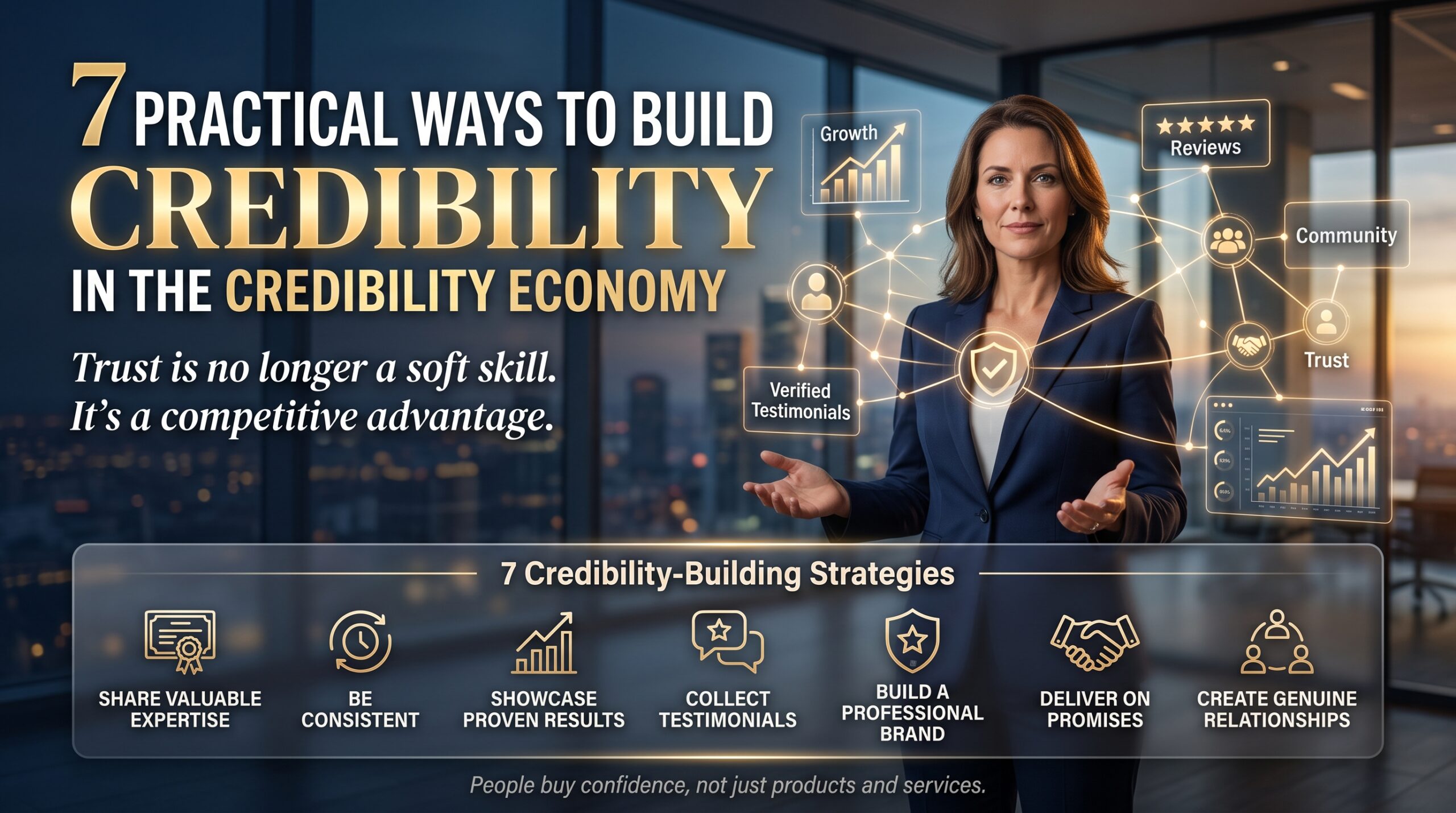
7 Practical Ways to Build Credibility in the Credibility Economy
1. Make Your Reviews Work Harder
Ask every satisfied customer for a review, make it easy with a direct link, and reply to every review, good or bad. A calm, helpful reply to a negative review often builds more trust than a page of five-star ratings. Never buy or invent reviews; the risk to your reputation and legal standing is not worth it.
2. Show the Real People Behind the Brand
Put names, faces, qualifications and experience on your website. A plumber in Brisbane, a dentist in Perth or an accountant in Adelaide wins trust faster when customers can see who they will be dealing with and read how long they have been doing the work.
3. Publish Proof, Not Promises
Swap vague slogans for specifics. Instead of “we deliver great results”, share a short case study: the problem, what you did, the measurable outcome and a quote from the client. Proof like this is what Google and customers both look for when judging expertise.
4. Build a Fast, Secure, Honest Website
A slow, confusing or insecure website quietly destroys credibility. Clear pricing or price guides, plain-English terms, visible contact details and quick loading all signal professionalism. Our website design and SEO service builds trust signals into the site from day one.
5. Be Consistent Across Every Channel
Your Google Business Profile, website, social profiles and email should all tell the same story with the same details. Inconsistency raises doubt. A steady, genuinely useful presence on social media and in your inbox-based email marketing shows customers you are reliable before they ever pick up the phone.
6. Earn Mentions From Trusted Third Parties
Local news, industry associations, suppliers, community groups and respected bloggers all lend borrowed credibility. A single relevant mention from a trusted source can be worth more than a month of ad spend because the audience already believes the messenger.
7. Keep Your Promises, Visibly
Credibility is ultimately built by behaviour. Respond quickly, deliver what you quoted, fix mistakes openly and follow up after the sale. Every kept promise is a data point that customers, and algorithms, can read.
Credibility Economy Examples Across Australian Cities
The same principles play out differently depending on where you operate, so it helps to think locally.
Melbourne: Competition is intense in food, health and professional services. Businesses that publish detailed local guides and collect steady reviews tend to stand out. See how we support digital marketing in Melbourne.
Sydney: With high ad costs, many Sydney brands are shifting budget towards content and reputation, which lowers long-term acquisition costs. Explore our Sydney digital marketing agency services.
Brisbane: Trades, property and tourism businesses rely heavily on word of mouth, which makes review management and local search essential. Learn about digital marketing in Brisbane.
Perth: Distance from the eastern states makes local proof and community reputation especially valuable. Visit our Perth digital marketing page.
Adelaide and Canberra: Smaller, closer-knit markets reward consistency. A reputation built here travels fast. See our Adelaide and Canberra pages, or browse all locations we serve, including the Gold Coast, Hobart, Newcastle and Geelong.
How to Measure Trust and Prove Return on Investment
Trust can feel intangible, but its effects are measurable. Track these indicators over time:
- Branded search volume: more people searching for your business name is a strong sign of growing recognition.
- Review quantity, quality and recency: aim for a steady flow rather than a one-off burst.
- Direct and referral traffic: visitors who arrive without clicking an ad already trust you.
- Conversion rate: trusted brands convert a higher share of visitors into enquiries.
- Sales cycle length and discounting: trust shortens the time to decision and reduces the pressure to cut prices.
Review these monthly and compare them with your ad spend. Many businesses discover that their cost per acquisition falls as credibility rises, because organic and referral channels start carrying more of the load.
Where Paid Advertising Still Fits
None of this means you should switch ads off. Paid media is excellent for reaching new audiences quickly and for capturing people who are actively searching. The smart move is to let credibility amplify your advertising. When your ads point to a page full of reviews, proof and clear information, every click is more likely to convert. Our Google advertising and digital advertising specialists build campaigns that send traffic to trust-rich landing pages, so you pay once and benefit twice.
Think of it as a partnership. Ads create the introduction, and credibility closes the deal. If you want a clear picture of costs, you can compare our SEO packages and Google Ads packages or view every option on our packages page.
Frequently Asked Questions About the Credibility Economy
What does the credibility economy mean for small business?
It means a small business can compete with larger rivals by being demonstrably more trustworthy. Genuine reviews, local expertise and transparent service often matter more to buyers than a big advertising budget.
Is trust more important than advertising?
They work best together. Advertising brings attention and trust converts it. In the credibility economy, trust is the asset that keeps paying off after the ad spend stops.
How long does it take to build credibility online?
Most businesses see early gains from review collection and website improvements within weeks, while stronger search visibility and brand recognition typically build over several months of consistent effort.
How can I improve my credibility in Google search?
Focus on E-E-A-T: show real authors and experience, publish helpful and accurate content, earn reputable mentions and keep your website secure and easy to use.
Conclusion: Build Trust First, Then Amplify It
The credibility economy rewards businesses that earn belief before they ask for the sale. Advertising will always have a place, but its power now depends on the trust sitting behind it. Start with the basics: collect reviews, show your people, publish proof and keep your promises. Then layer in search and paid media to amplify what is already working.
Ready to turn trust into growth? Talk to our team for a free consultation, explore all of our digital marketing services, or read more practical guides on the Digital Marketing Agencies blog. You can also call