


Research fatigue is the moment a customer stops comparing and starts choosing. They have opened a dozen tabs, skimmed three review sites that contradict each other, watched half a video, and now they simply want to pick someone they trust and be done with it. For Australian businesses, that shift changes what good marketing looks like. This guide explains the research fatigue economy, why it is growing, and how to become the business people choose when they’re tired of comparing, with practical steps any digital marketing agency can help you put in place.
The short version is this: more information doesn’t create better decisions, it creates tired buyers. Tired buyers lean on shortcuts like familiarity, reviews, clear pricing and a name they’ve seen more than once. If your brand supplies those shortcuts, the tiredness works in your favour. If it doesn’t, you get compared to death and lose to whoever feels safest.
What Is Research Fatigue?
Research fatigue is the mental tiredness that builds up when a buyer has to gather, read and weigh too much information before a purchase. It shows up in both consumer and business buying: choosing an electrician, a software tool, an accountant or a marketing partner. After enough tabs and tutorials, the brain looks for the quickest safe exit.
The idea sits close to two better-known concepts. Psychologist Barry Schwartz popularised the “paradox of choice”, the finding that more options can make people less satisfied and less likely to act. And decision fatigue describes how the quality of choices drops as the number of decisions piles up. It is what marketers see when those forces hit the buying journey.
Research Fatigue vs Decision Fatigue vs Choice Overload

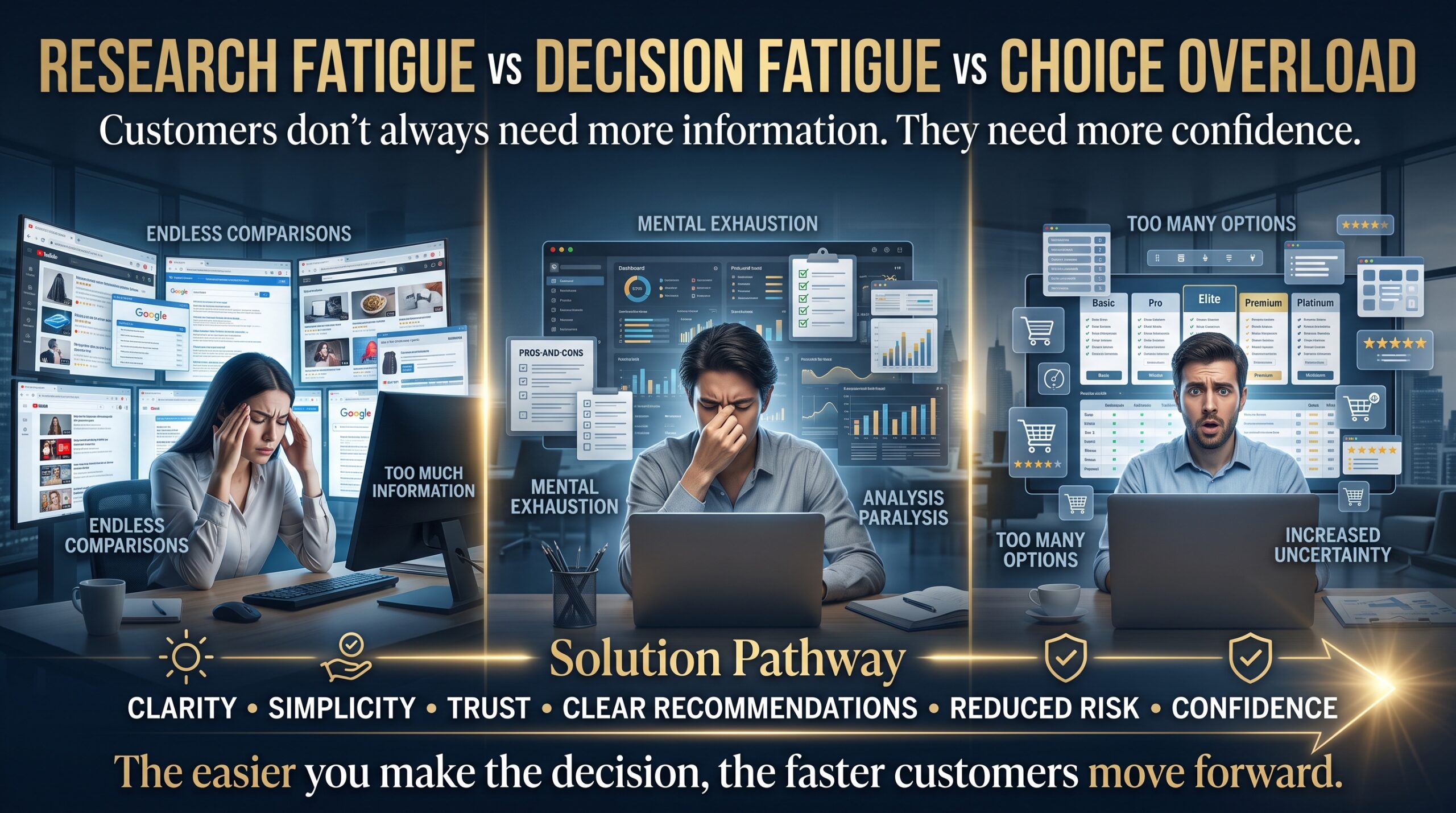
| Term | What it means | What the customer does | Your marketing response |
| Research fatigue | Too much information to gather and compare | Stops researching and picks a familiar name | Be present and consistent at every stage |
| Decision fatigue | Too many decisions in a row | Defaults to the easiest option | Make the next step obvious |
| Choice overload | Too many similar options | Delays or abandons the purchase | Simplify packages and pricing |
Why the Research Fatigue Economy Is Growing
Ten years ago, finding three quotes took effort. Today it takes one search. That sounds like a win for buyers, but the sheer volume of results, ads, sponsored lists, AI summaries and recycled “best of” articles has created a new problem: everything looks the same, and everyone claims to be the best.
Google’s own consumer research describes this as the “messy middle”, a loop where people keep exploring and evaluating rather than moving in a straight line from interest to purchase. You can explore the idea on Think with Google. Analyst firms such as Gartner describe business buying in similar terms: long, looping and shared between several people, which multiplies the tiredness.
Add fake or incentivised reviews to the mix and buyers learn to distrust what they read. In Australia, the ACCC has made it clear that misleading reviews can breach consumer law, so honest, verifiable proof is now a competitive advantage rather than a nice extra.
AI-generated summaries and chat tools add another layer. They promise a shortcut, but buyers still want a human-feeling signal before they hand over money, which is why recognisable brands and verifiable reviews keep winning even as the way people search changes. Shortcuts get used by everyone, so the trust signals behind them matter more than ever.
Signs of Research Fatigue in Your Own Data
- Long journeys before enquiry. Visitors come back again and again before they finally convert.
- Rising branded searches. More people searching your business name plus “reviews” or “pricing”.
- Comparison pages with high exits. Visitors read, get overwhelmed and leave.
- Enquiries that start with “I’ve been looking for ages”. Your sales team hears the tiredness first.
- Strong direct and returning traffic. People are coming back to a name they already trust.
How Customers Stop Comparing and Start Trusting
When the tiredness sets in, buyers don’t suddenly become irrational. They switch from analysing to using trust shortcuts. Understanding those shortcuts tells you exactly what to publish and where.
| Trust shortcut | What the buyer thinks | What to put in front of them |
| Familiarity | x | Consistent presence in search, social, email and remarketing |
| Social proof | “Others like me chose them.” | Genuine reviews, case studies and named results |
| Clarity | “I can understand this quickly.” | Plain pricing, simple packages and short explanations |
| Authority | “They know their stuff.” | Useful guides, original data and expert commentary |
| Low risk | “If it goes wrong, I’m covered.” | Free consultations, clear reporting and straightforward terms |
Notice that none of these require shouting louder. They require being consistent, honest and easy to understand, which is exactly what tired buyers are craving.
Six Ways to Win When Research Fatigue Sets In
- Be easy to find at every stage. Familiarity starts with visibility. Strong SEO services put you in front of buyers early, so your name feels known by the time they’re ready to decide.
- Make your Google Business Profile do the heavy lifting. Keep your hours, services and photos current, and ask happy customers for honest reviews. Google’s Business Profile is often the last page a tired buyer checks.
- Show proof, not claims. Replace “we’re the best” with results, case studies and customer quotes. Our content marketing approach focuses on useful, evidence-led pages, which fits Google’s guidance on helpful, people-first content.
- Simplify the choice. Three clear options beat ten confusing ones. Publish transparent pricing, such as our SEO packages and Google Ads packages, so buyers can decide without chasing quotes.
- Stay in front of people between visits. Google Ads remarketing and email marketing keep your name present while the buyer is still deciding. Done well, it feels like a helpful reminder rather than a chase.
- Reduce the risk of saying yes. Offer a free consultation, set out what reporting looks like, and make the next step small. You can contact our team to see what that looks like in practice.
Research Fatigue Mistakes That Push Customers Away
Most businesses make the problem worse without realising it. These are the common culprits.
- Hiding your pricing. “Contact us for a quote” forces one more round of research. Even a price range helps.
- Too many options. A page with nine near-identical packages is a gift to your competitor’s simpler page.
- Inconsistent branding. If your website, social profiles and ads all look and sound different, you lose the familiarity that builds trust.
- Thin, generic content. Copy that could belong to any company gives tired buyers no reason to pick you.
- Ignoring reviews. Unanswered or unsolicited-looking reviews erode confidence quickly.
- A slow or confusing website. Tired buyers have no patience for friction. A well-planned website design and SEO project removes it.
Two Businesses, One Tired Customer: A Research Fatigue Example
Imagine a homeowner looking for a landscaper after a week of research. Business A has a polished website but no prices, three-year-old reviews and a contact form. Business B has a clear page showing three packages, recent reviews with first names and suburbs, a short project gallery and a phone number that answers.
Both landscapers could be equally skilled. But the homeowner is tired, and Business B asks for less effort. That’s the whole idea in a nutshell: the winner is often the business that reduces the buyer’s work, not the one with the cleverest slogan. The same pattern plays out in B2B, where a stakeholder wants a safe, defensible choice to take back to their boss.
Research Fatigue Across Australian Cities
Competition and buyer behaviour vary by market, so the way you build trust should too. Here’s a general look at how buyer tiredness tends to show up in each major city, with a link to the relevant local page.
| City | How buyer tiredness tends to show up | Trust move that helps most | Local page |
| Sydney | Dense competition, so shortlists form fast and brand recognition matters | Strong reviews and a clear point of difference | Sydney agency page |
| Melbourne | Research-heavy buyers who compare many providers | In-depth guides and transparent pricing | Melbourne agency page |
| Brisbane | Strong reliance on local recommendations and map results | Local SEO and a well-kept Google Business Profile | Brisbane agency page |
| Perth | Fewer local specialists, so credibility is closely checked | Case studies and proof of results | Perth agency page |
| Adelaide | Tight business networks where reputation travels | Consistent presence and genuine testimonials | Adelaide agency page |
| Canberra | Government and professional services buyers who value due diligence | Clear credentials and low-risk terms | Canberra agency page |
If you are based in Brisbane and want a dedicated local team, also see digitalmarketingagencybrisbane.au for city-specific services. Businesses outside the big six can still work with us remotely across Australia.
Measuring Whether Customers Trust You
You can’t manage what you can’t see. Inside Google Analytics 4 and Google Search Console, a handful of signals tell you whether your trust-building is working.
- Branded search impressions and clicks over time.
- Returning and direct visitors compared with new visitors.
- Assisted conversions and the time lag between first visit and enquiry.
- Review volume, recency and average rating.
- Enquiry quality: are leads arriving more informed and more ready to buy?
Track these quarterly rather than daily. Trust builds slowly, and so does the evidence.
Learn the Skills Behind Trust-Led Marketing
If you’d rather build this capability in-house, structured training can help. Logitrain offers a digital marketing course and a digital marketing job program for people who want practical skills in SEO, ads and analytics. Teams often use both routes: training for the basics and an agency for execution at scale.
Frequently Asked Questions About Research Fatigue
What is research fatigue in marketing?
Research fatigue is the point where customers are tired of comparing options and choose the brand that feels familiar, clear and safe. Marketers see it as long journeys that end with a quick, trust-based decision.
How do I reduce research fatigue for my customers?
Make information easy to find and easy to compare. Publish clear pricing, keep your packages simple, show recent reviews and answer common questions on the page so buyers don’t need another tab.
Does buyer fatigue affect B2B buying too?
Yes. Business buyers often research as a group, which means more opinions, more documents and more fatigue. Clear case studies, honest reporting and low-risk starting offers help a champion win internal approval.
Which digital marketing channels build trust fastest?
Reviews and Google Business Profile tend to move quickest for local businesses, while SEO content, email and remarketing build familiarity over time. The right mix depends on your audience and sales cycle.
How long does it take to build customer trust online?
Early signals like better reviews and clearer pages can show results within weeks, but lasting familiarity usually takes several months of consistent presence.
Final Thoughts: Turn Research Fatigue Into Trust
This economy rewards businesses that make choosing easy. Be visible, be clear, show proof and lower the risk. Ready to become the safe, obvious choice? Explore our digital marketing packages, pick your local page above or book a free consultation to plan a trust-led strategy for your business.