


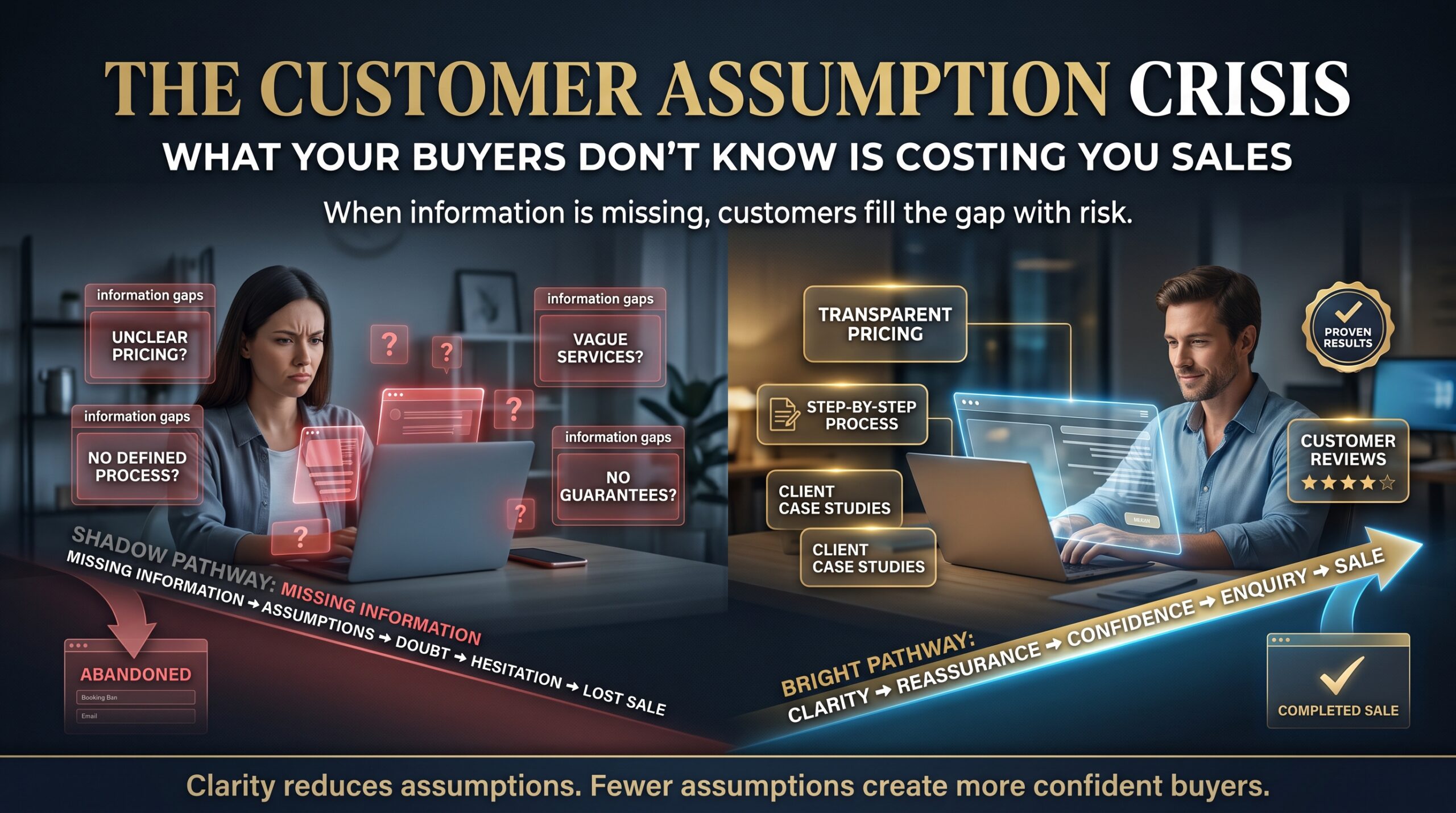
The customer assumption crisis starts the moment you believe your buyers understand what you do, why it matters and how to buy it. They usually do not. Your team lives inside your product every day, so every term, benefit and process feels obvious. Your buyers arrive cold, skim a page for a few seconds and leave with questions nobody answered. This guide explains how the customer assumption crisis quietly drains sales, how to spot it in your data, and how smarter digital marketing services in Australia close the gap.
Whether you run a business in Sydney, Melbourne or Brisbane, the pattern is the same: the sale is often lost long before anyone contacts you. Here is how to find it and fix it.
What Is the Customer Assumption Crisis?
The customer assumption crisis is the gap between what a business assumes its buyers know and what those buyers actually understand. It shows up as unread product pages, unanswered objections and ads that promise something prospects cannot picture. Psychologists describe a related effect as the curse of knowledge: once you know something, it is hard to imagine not knowing it.
In practice, the assumptions look like this:
- You assume buyers know your industry jargon, so your headlines use it.
- You assume buyers already see why your service matters, so the page jumps straight to features.
- You assume buyers know what to do next, so the call to action is vague or buried.
- You assume buyers trust you, so proof such as reviews, case studies and pricing guidance is thin.
None of these assumptions is careless. They are the natural result of being close to your own business. The cost is that every one of them removes a reason to buy.
How the Customer Assumption Crisis Costs You Sales
The damage rarely arrives as one dramatic failure. It leaks out of your funnel in three places.
Buyers leave before they understand the offer
Most visitors decide within moments whether a page answers their question. If your headline describes a category instead of a benefit, the visit ends there. That shows up as high bounce rates, short sessions and traffic that never turns into enquiries, which is why the customer assumption crisis is so often mistaken for a traffic problem when it is really a clarity problem.
Your ads attract clicks but not customers
Advertising can only deliver people who click. If the ad, the landing page and the offer are not written for someone who knows nothing, you pay for visitors who bounce. Wasted ad spend is one of the clearest symptoms of the customer assumption crisis.
Search visibility gaps hide you from ready-to-buy audiences
Businesses write in the words they use. Buyers search in the words they have. When your site talks about “solutions” and buyers search for “how much does it cost”, you are invisible at the exact moment of intent. Closing that vocabulary gap is the heart of effective SEO.
Warning Signs of a Customer Assumption Crisis
Look for these patterns in your analytics and in your inbox:
- High traffic, few enquiries. People arrive but do not act.
- Repeat questions. Sales calls open with the same basic questions again and again.
- Price shock. Prospects disappear after seeing a quote because the value was never explained.
- Weak landing page results. Paid campaigns bring clicks but little conversion.
- Form or cart abandonment. Visitors start the process and stop when something is unclear.
Free tools help you confirm these signs. Google Analytics shows where visitors drop off, and the queries report in Google Search Console reveals the actual words buyers type before they find you. Google’s Search Central documentation explains how search works, and Think with Google publishes research on consumer behaviour worth reading before you plan your next campaign.
How to Fix the Customer Assumption Crisis in Five Steps
You do not need a huge budget to begin. You need evidence in place of assumptions:
- Ask real buyers. Interview five recent customers and five lost leads. Note the words they use and what confused them.
- Rewrite for a beginner. Replace jargon with plain language and lead every page with the outcome, not the feature.
- Answer objections on the page. Add FAQs, process steps, pricing guidance and proof next to the call to action.
- Match content to search intent. Build pages for the questions buyers type into Google, from “what is” to “how much” to “best for”.
- Test and measure. Change one element at a time and track enquiries, not just visits.
Where Digital Marketing Closes the Customer Assumption Gap
Every marketing channel can either widen the gap or close it, depending on how it is used. You can compare options on our packages page or browse the full services list.
SEO that matches buyer language
Search engine optimisation reaches people at the moment they are asking questions. Our SEO services start with the words your buyers use, then build content and technical foundations around them. You can review options on the SEO packages page.
Google Ads that educate before they sell
Google advertising works best when the keyword, the ad and the landing page tell one clear story. See the Google Ads packages for management options, and read Google’s own guidance in Google Ads Help. For local buyers, a complete Google Business Profile answers basic questions before anyone visits your site.
Websites, content and email that answer the question
A website design and SEO project can restructure pages around buyer questions. Content marketing and email marketing keep educating people who are not ready yet, while social media marketing reaches new audiences with simple, jargon-free messages. Online retailers can also explore eCommerce marketing.
Digital Marketing Support Across Australian Cities
Buyer questions change from market to market, and local context matters. We support businesses in these cities:
- Digital marketing agencies Sydney: office in Surry Hills.
- Digital marketing agencies Melbourne: office in West Melbourne.
- Digital marketing agencies Brisbane: office in Brisbane City.
- Digital marketing agencies Adelaide.
- Digital marketing agencies Perth.
- Digital marketing agencies Canberra.
- We also work with businesses in the Gold Coast, Hobart, Darwin, Newcastle, Wollongong, Geelong, Sunshine Coast, Townsville and Cairns.
Not sure which service fits? Check the locations page or read answers on the FAQs page.
Frequently Asked Questions About the Customer Assumption Crisis
What is the customer assumption crisis?
It is the gap between what you assume buyers know and what they actually understand. The customer assumption crisis leads to lost enquiries, wasted ad spend and weak search visibility.
How do I know if my business has a customer assumption problem?
Check for traffic without enquiries, repeated basic questions in sales calls and landing pages that bounce paid clicks. A handful of customer interviews will confirm it quickly.
Can SEO fix the customer assumption crisis?
SEO helps by aligning your content with the words and questions buyers actually use, so the right people find clear answers. It works best alongside stronger website copy and a clear call to action.
Do Google Ads help or make it worse?
They help when the ad and landing page speak to a beginner. They make things worse when they send buyers to pages full of jargon, because you pay for every click.
How long does it take to see results?
Paid campaigns can produce data quickly, while SEO usually builds over months. Timing depends on your market, website and competition, so a strategy session is the best place to set expectations.
Where do I start?
Start with five customer conversations. Then book a free consultation to turn what you learn into a marketing plan.
Conclusion: Stop Letting the Customer Assumption Crisis Cost You Sales
The customer assumption crisis is expensive precisely because it is invisible. Nobody tells you they left because your headline made no sense. The fix is to replace assumptions with evidence, write for the person who knows nothing and measure what changes. Ready to find the gaps? Book a free consultation, explore our services or call 1300 649 299 and start closing the distance between what you know and what your buyers understand.