


Marketing attribution is what separates a team that believes its marketing is working from a team that can prove why. Walk into almost any monthly review and you’ll see the first kind of meeting: leads are up, traffic looks healthy, the owner feels busy, and everyone nods. Then somebody asks the simple question. Which activity actually caused this? The room goes quiet.
We call this the marketing consensus problem. Everybody agrees the marketing is working, because the headline numbers are good. Nobody can explain the cause, because the data was never set up to answer that. In this guide we’ll look at why it happens, what it costs, and how Australian businesses in Sydney, Melbourne, Brisbane, Perth, Adelaide and Canberra can fix their marketing attribution without needing an enterprise analytics budget.
What Is the Marketing Consensus Problem?
The marketing consensus problem is a shared belief without shared evidence. The owner credits the new website. The agency credits the Google Ads campaign. The sales team credits referrals. The social media manager credits last month’s video. Each story is plausible, each person is sincere, and nobody is lying. They’re just looking at different slices of the same customer journey.
Good marketing attribution connects those slices. It tells you which touchpoints genuinely contributed to a sale or enquiry, and how much. Without it, agreement becomes a polite way of avoiding the question, and budget decisions end up being made on confidence rather than facts.
Why Everyone Agrees Marketing Is Working but Nobody Can Explain Why
If you’ve ever wondered how a business can feel certain about results it can’t explain, these are the usual reasons.
1. Rising numbers take the credit automatically
When revenue rises, marketing is the easy hero. But seasonality, word of mouth, pricing changes, a competitor’s stock problem or a good news cycle can all lift results. Without a way to separate those effects, marketing gets credit it may not have earned, and sometimes blame it doesn’t deserve.
2. Every platform claims the same sale
Google Ads, Meta, email and your own analytics tool each use their own rules to claim a conversion. Add the platform reports together and you often get more sales than your bank account shows. Each report is internally consistent. None of them is the whole truth.
3. Last-click rewards the finish line
Last-click reporting gives all the credit to the final touch before a conversion, typically a branded search or a direct visit. The blog post, the video and the first ad that created awareness months earlier get nothing. Over time the team quietly concludes that the bottom of the funnel is the only part that works.
4. Dark social, direct traffic and offline influence
Plenty of influence leaves no trail. A customer hears about you from a friend, searches your name later and shows up as “direct”. A phone call from a map listing never reaches your analytics. Weak marketing attribution treats these as noise when they’re often your best leads.
5. Brand and performance get measured the same way
Brand activity builds demand slowly, and performance activity captures it quickly. Judge both by cost per click and brand loses every time, even when it’s quietly feeding the campaigns that look efficient.
6. Nobody owns the question
Reports tend to measure activity: impressions, clicks, posts, sessions. Very few measure outcomes tied to revenue. Since no one is responsible for explaining why results move, nobody asks.
Marketing Attribution Warning Signs: What the Report Says vs. What It Might Mean

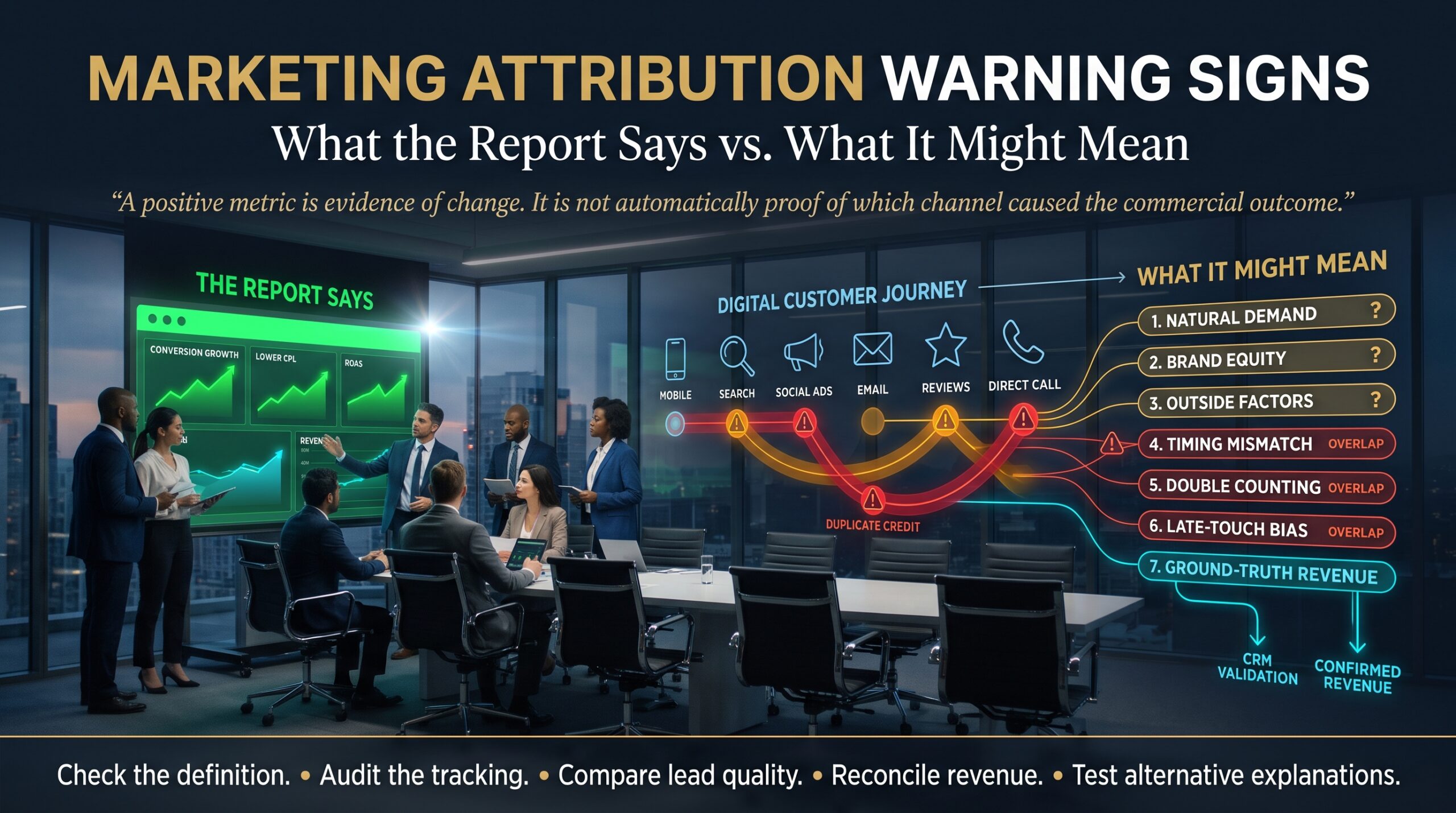
| What the report says | What it might really mean | How to test it |
| Leads are up 30% this quarter | Seasonality, lower-quality leads or double-counted conversions | Compare to last year and check lead-to-sale rate |
| Branded search is our best channel | It’s capturing demand created elsewhere | Ask customers how they first heard of you |
| Social media doesn’t convert | It influences early and gets no last-click credit | Look at assisted conversions and view paths |
| Google Ads and Meta both report great ROAS | Both are claiming the same customers | Compare platform totals to actual CRM sales |
| Direct traffic is growing | Untracked word of mouth, email or offline ads | Use campaign tags and a “how did you hear” field |
What Weak Marketing Attribution Really Costs
The cost isn’t just a messy report. It shows up in decisions.
- Wasted budget: money keeps flowing to channels that look good in reports but add little real demand.
- Cut the wrong things: upper-funnel work like SEO content or video gets paused because it “doesn’t convert”, and results slump a few months later.
- Poor bidding signals: Smart Bidding in Google Ads learns from the conversions you give it. Feed it low-quality events and it optimises toward them.
- Trust problems: when an owner can’t verify what an agency or in-house team reports, every renewal becomes an argument.
- Stalled growth: you can’t confidently scale what you can’t explain.
How to Fix Marketing Attribution Step by Step
You don’t need a perfect model. You need a better one than guesswork, and a habit of testing it.
- Define the conversion that matters. Not clicks or form views. Use qualified enquiries, booked appointments or sales.
- Clean up tracking. Set up conversions properly in Google Analytics, use Google Tag Manager, and check each event fires once. Link analytics with Google Ads and Search Console.
- Use consistent campaign tags. Agree on UTM naming rules so email, social and paid links can actually be separated in reports.
- Ask the customer. Add a “How did you first hear about us?” field to forms and train staff to ask on calls. Self-reported data catches the word-of-mouth and offline influence your tools miss.
- Connect marketing to the CRM. Import offline conversions or sales stages so you can see which sources produce revenue, not just leads.
- Compare more than one view. Look at last-click and data-driven reports side by side, and treat the gap between them as a clue about which channels assist rather than close.
- Run simple incrementality tests. Pause a channel in one region for a few weeks, or run a geo holdout, and watch what actually changes. Keep a change log so you can explain movements later.
- Report on outcomes monthly. Replace activity metrics with cost per qualified lead, sales by source and payback period.
For more on how the pieces fit together, see our SEO services, Google Ads management and digital advertising pages. Think with Google and IAB Australia also publish useful measurement guidance for local marketers.
Marketing Attribution Models Compared
| Approach | Strength | Blind spot |
| Last click | Simple and easy to report | Ignores everything that built awareness |
| First click | Highlights what starts journeys | Ignores the nurturing and closing steps |
| Linear or time decay | Shares credit across touchpoints | Weighting is a rule, not evidence |
| Data-driven | Uses actual conversion paths to split credit | Needs enough data and still can’t see offline |
| Incrementality testing | Shows what truly changes when spend changes | Takes planning and enough volume |
One practical note: analytics tools change which models they offer, and Google Analytics 4 has narrowed its built-in options over time, so check what’s available in your own property. The principle stays the same. No single model is the truth; use several and let experiments settle arguments.
Building Marketing Attribution Skills In-House
Many small and mid-sized businesses discover that the real gap is skill, not software. Someone on the team needs to understand analytics, campaign structure and how customers move between channels. That’s a learnable skill. Logitrain’s digital marketing courses and the digital marketing job program are good starting points for marketers who want hands-on grounding in these areas.
If you’d rather have specialists handle it, our team can review your tracking, fix your conversion setup and build reporting that ties to revenue. Explore our full range of services, including content marketing, website design and SEO, email marketing, social media and eCommerce marketing, or compare SEO packages and Google Ads packages.
Marketing Attribution Support Across Australian Cities
Customer journeys look different in every market, so measurement needs local context. We work with businesses across the country:
- Sydney: competitive, high-cost markets where digital marketing agencies in Sydney help teams prove which channels justify the spend.
- Melbourne: digital marketing in Melbourne for retail, professional services and education brands with long consideration cycles.
- Brisbane: digital marketing agency support in Brisbane for growing local service and trade businesses.
- Perth: digital marketing in Perth for resources, construction and services businesses with regional reach.
- Adelaide: digital marketing agencies in Adelaide for SMEs that need clear reporting on a tight budget.
- Canberra: digital marketing in Canberra for government suppliers and professional services.
See all service areas on our locations page.
Frequently Asked Questions
What is marketing attribution?
Marketing attribution is the process of identifying which marketing touchpoints contribute to a sale or enquiry, and how much credit each deserves, so you can invest in what genuinely works.
Why can’t my business explain why marketing is working?
Usually because reports track activity rather than outcomes, platforms each claim the same conversions, and influence from word of mouth, brand and offline channels isn’t captured. Strong results then get credited by belief instead of evidence.
What is the best marketing attribution model?
There isn’t a single best model. Last-click is simple but biased, data-driven models use conversion paths, and incrementality testing shows true cause and effect. Most businesses should compare several.
How do I track marketing results when customers call or visit in person?
Use call tracking, ask “how did you hear about us” on every enquiry, and record the answer in your CRM. Self-reported data fills the gaps analytics can’t see.
Can an agency help fix marketing attribution?
Yes. An agency can audit your tracking, clean up conversions, connect your CRM and build reporting around revenue. Visit our FAQs or contact us to discuss your setup.
Final Thoughts: From Agreement to Evidence
Agreement feels good, but it isn’t proof. The businesses that grow steadily are the ones that can say not just “marketing is working”, but which part is working, for whom, and at what cost. Better marketing attribution doesn’t need a bigger budget. It needs cleaner tracking, honest questions and a habit of testing.
Want a second pair of eyes on your measurement? Learn about our team, browse the latest articles on our blog, or call 1300 649 299 to talk through your reporting.