


Marketing channel conflict is what happens when Google Ads, Meta, email, organic search and every other platform you pay for each claim credit for the same customer. Add up the conversions inside each dashboard on a Monday morning and the total is usually bigger than the number of orders sitting in your CRM. Nobody is lying to you. Every platform is simply measuring the world from its own seat, and from that seat it always looks like the hero.
For Australian businesses, marketing channel conflict is more than an irritating spreadsheet problem. It decides where your next $10,000 goes. When the numbers can’t all be true, budgets drift towards whichever platform reports the loudest, quieter channels that actually started the journey get cut, and your agency, your in-house team and your sales manager end up arguing over figures that were never comparable in the first place.
This guide explains why marketing channel conflict happens, what it quietly costs you, how to spot it in your own data, and a practical framework to settle it without buying another piece of software. If you’d rather have a specialist team untangle it, our digital marketing services cover SEO, Google Ads, social media and reporting under one roof.
What Is Marketing Channel Conflict?
Marketing channel conflict is the overlap and disagreement between channels when several of them report credit for one conversion, or when channels end up competing for the same budget and the same audience. It shows up in two ways. The first is reporting conflict: Google Ads says it drove 48 sales, Meta says 36, your email platform says 22, and Google Analytics 4 shows something different again. The second is operational conflict: your paid search team bids on terms your SEO already ranks for, or your social team pushes a discount while your email team sends a different one.
Common warning signs include:
- Platform-reported conversions add up to far more than the sales in your CRM or accounting software.
- Branded search campaigns look like your best performer while social, SEO and content seem to deliver nothing.
- Meta reports a sale as its own, GA4 files it under organic search, and Google Ads claims it as a paid click.
- Cost per lead climbs every time you scale spend, even though each platform insists its own cost per acquisition is healthy.
- Customers tell your sales team they found you on Google while your tracking says Facebook.
Why Every Platform Claims the Same Customer
Each platform grades its own homework
Google Ads, Meta Ads Manager, LinkedIn, TikTok and your email tool all use their own attribution rules, their own conversion windows and their own definition of a view. Meta can count a sale after someone merely saw an ad and bought later. Google Ads counts a click on a search ad. Each system only sees its own slice of the journey, so each assumes its slice mattered most. You can read how the platforms describe their own approach in the Google Analytics Help Centre and the Meta Business Help Centre.
Real customers don’t travel in straight lines
Picture a homeowner in Brisbane looking for a solar installer. She sees an Instagram video on the train, searches the brand name two days later, clicks a Google ad, reads reviews, gets a follow-up email, then finally enquires on her laptop at night. That’s five touchpoints across at least three platforms, and every one of them carries a tracking pixel and a reason to claim the enquiry. This is marketing channel conflict in its simplest form: one customer, five claims, one sale.
Branded search takes the bow
Branded search is the biggest culprit. People who already know your name will type it into Google whatever else you do, and a branded Google Ads campaign collects them at a low cost per click and a very high conversion rate. On paper it looks like your star channel. In reality, much of that demand was created earlier by SEO, word of mouth, social content or a referral. When marketing channel conflict hides inside branded search, businesses over-invest in the final click and starve the work that created the interest.
Privacy changes and cross-device gaps
Tracking is also patchier than it used to be. Browser cookie restrictions, Apple’s App Tracking Transparency, consent banners and people hopping between phone, laptop and tablet all leave holes in the data. Platforms fill those holes with modelled conversions, each using its own model. Australian businesses also need to handle consent and personal information properly under the Privacy Act 1988, so it’s worth reading the guidance from the Office of the Australian Information Commissioner before adding more tracking.
The Real Cost of Marketing Channel Conflict
Here is a simple, hypothetical example. A Brisbane home-services business spends $10,000 a month across four channels, and each platform reports its own conversions.
| Source | Reported conversions | Why the number is inflated |
| Google Ads | 48 | Includes many people who searched the brand name after seeing other marketing |
| Meta Ads | 36 | Counts view-through conversions where no click happened |
| Email platform | 22 | Credits any email opened before purchase |
| Organic search (GA4) | 30 | Overlaps with paid clicks and returning visitors |
| Total claimed | 136 | Same customers counted more than once |
| Actual new customers in CRM | 74 | The number that pays the bills |
The channels claim 136 sales between them while the CRM shows 74. The extra 62 aren’t fake. They’re the same customers being counted again and again. That gap is where the damage happens, because marketing channel conflict quietly pushes you into decisions like these:
- Wasted budget. Money moves to the channel with the most generous reporting, not the one that grows revenue.
- Cutting channels that actually work. Content, SEO and social often start journeys but rarely get the final click, so they look weak under last-click reporting.
- Inflated efficiency. Divide spend by platform-reported sales and your cost per acquisition looks lower than it really is, so you scale straight into diminishing returns.
- Team friction. Agencies and in-house staff defend their own numbers instead of solving the shared problem.
- Slow decisions. Leadership stops trusting the data, and budget meetings turn into arguments.
How to Spot Marketing Channel Conflict in Your Own Data
You don’t need a data scientist for this. Run these five checks this week:
- Add up the platforms. Total the conversions across Google Ads, Meta, email and everything else, then compare the result with orders or qualified leads in your CRM. Any meaningful gap is a flag.
- Compare GA4 against the ad platforms. Open Google Analytics 4 and compare its conversion count for each channel with what the matching ad platform reports.
- Split branded and non-branded search. If branded campaigns produce most of your conversions, your top-of-funnel work is probably being under-credited.
- Review conversion paths. Look at assisted conversions and path reports to see how many customers touch two or more channels before buying.
- Ask your customers. Add a “How did you hear about us?” question to forms and train your sales team to ask it on calls. Self-reported answers are imperfect, but they often reveal channels that tracking can’t see.
A 6-Step Framework to Resolve Marketing Channel Conflict

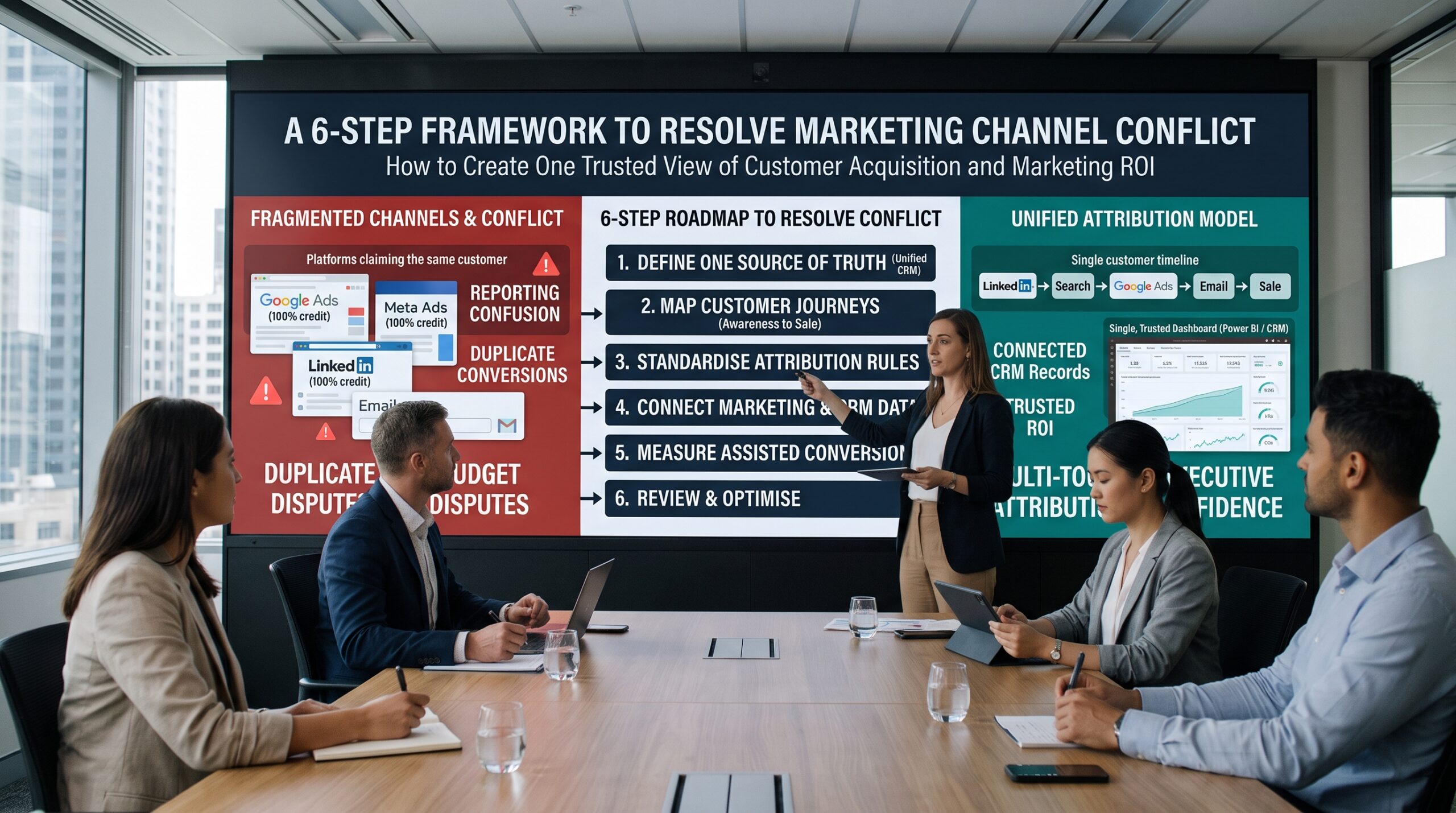
Step 1: Choose one source of truth
Your CRM or accounting system, not an ad platform, should decide what counts as a sale, and that single rule defuses most marketing channel conflict. Everything else is a supporting witness.
Step 2: Standardise your tracking
Use consistent UTM parameters, clear naming rules, properly configured GA4 conversion events, Google Tag Manager and server-side options such as the Meta Conversions API where they make sense.
Step 3: Agree one attribution model and one reporting window
Pick a model, write it down and use it for every channel comparison. Which model you choose matters less than everyone using the same one, because mismatched models are a hidden driver of marketing channel conflict.
Step 4: Separate branded from non-branded campaigns
Run them as different campaigns, set different targets and report them separately, since blended branded numbers are the fastest way to feed marketing channel conflict. Branded search is a harvesting tool. Non-branded search is a growth tool. Mixing them hides the truth about both.
Step 5: Capture self-reported attribution
Add a “how did you hear about us” field to your forms and a matching source field in your CRM. Answers like podcast or friend’s recommendation reveal demand no pixel could track.
Step 6: Test incrementality and watch blended numbers
Reduce or pause one channel in a single region or time period and see what happens to total sales. A geo test, such as holding spend steady in Perth while lowering it in Adelaide for a few weeks, often beats any dashboard. Alongside channel metrics, track blended measures such as total revenue divided by total marketing spend. Blended numbers can’t be double-counted, which is exactly why they calm down marketing channel conflict.
Attribution Models at a Glance
| Model | How it gives credit | Best for | Watch out for |
| Last click | All credit to the final touchpoint | Short sales cycles and simple reporting | Ignores everything that built awareness |
| First click | All credit to the first touchpoint | Measuring discovery channels | Ignores nurturing and closing work |
| Linear | Equal credit to every touchpoint | Long journeys with no clear leader | Treats a banner view like a sales call |
| Data-driven | Machine learning on your own path data | Accounts with enough conversion volume | Needs volume and is harder to explain |
Model availability inside GA4 and Google Ads changes over time, so check what your account currently offers before planning around it.
Marketing Channel Conflict Across Australian Cities
The mix of channels that collide differs from market to market. These are typical scenarios rather than rules, but they’re a useful starting point when auditing campaigns in your own city.
| City | Where conflict typically appears | First thing to check | Local page |
| Sydney | Crowded paid search auctions and competitors bidding on brand terms | Branded versus non-branded Google Ads split | Sydney |
| Melbourne | Social, email and eCommerce promotions overlapping on the same buyers | Meta, email and GA4 purchase counts side by side | Melbourne |
| Brisbane | Google Business Profile, Map Pack and paid ads all claiming local enquiries | Calls and direction requests counted twice | Brisbane |
| Perth | Trades, resources and B2B firms where sales are phone-led | Call tracking and the CRM source field | Perth |
| Adelaide | Strong word of mouth hiding behind paid channel credit | Self-reported “how did you hear” answers | Adelaide |
| Canberra | Longer B2B and government-adjacent sales cycles with many touchpoints | Multi-touch path reports | Canberra |
We also support businesses in the Gold Coast, Hobart, Darwin, Newcastle, Wollongong, Geelong, Sunshine Coast, Townsville and Cairns. If you’re in Brisbane and want a local team, visit Digital Marketing Agency Brisbane.
Which Channel Deserves the Credit? Give Each One a Job
| Channel | Its real job | Where it over-claims | A better question |
| SEO and content marketing | Builds trust and captures research-stage demand | Often under-credited, so it gets cut | Did it bring new people into the journey? |
| Google Ads | Captures existing intent quickly | Branded campaigns claim demand they didn’t create | What did non-branded campaigns add? |
| Social media | Creates demand and keeps the brand familiar | View-through conversions inflate results | Did sales rise while it was running? |
| Email marketing | Converts and retains people who already know you | Claims sales that would have happened anyway | Did it bring buyers back sooner or lift order value? |
| Digital advertising and eCommerce marketing | Builds reach and recovers abandoned carts | Retargeting claims the final click | Would these buyers have returned without it? |
When every channel has a defined role, marketing channel conflict turns into collaboration. Search ads stop being judged on awareness, social stops being judged on last-click sales, and your reporting finally reflects how customers really behave.
Marketing Channel Conflict Between Agencies and In-House Teams
The people problem is often bigger than the data problem. When one agency runs Google Ads, another runs social and an in-house marketer owns email, each party is rewarded for showing a good number in their own corner. That’s a perfect recipe for marketing channel conflict. A few habits help:
- Tie every channel owner to one shared goal, such as qualified leads or revenue, rather than platform-reported conversions.
- Produce one monthly report that uses a single attribution model for every channel.
- Review budgets across channels together, not in separate meetings.
If you’d like one team to look after the whole picture, compare our Google Ads packages and SEO packages, browse all digital marketing packages, or contact us for a tailored plan.
Skills and Tools That Make Reporting Easier
Clean data starts with people who know how to build it. The core toolkit is Google Analytics 4, Google Tag Manager, Looker Studio, a CRM such as HubSpot or Salesforce, and call tracking for phone-led businesses. If you want your in-house team to own these skills, Logitrain’s digital marketing course and digital marketing job program cover the fundamentals, with training delivered in Melbourne, Sydney and Brisbane and live online or in-house for Adelaide, Canberra, Hobart and Perth. For industry research, bookmark Think with Google Australia and IAB Australia.
Marketing Channel Conflict FAQs
What is marketing channel conflict?
It’s the situation where multiple marketing channels or platforms claim credit for the same sale, or compete for the same audience and budget, so the reported results can’t all be true at once.
Why do Google Ads and GA4 show different conversion numbers?
They use different attribution rules, different conversion windows and different counting methods, and Google Ads can credit a conversion to the date of the ad click while GA4 credits the date of the conversion. Neither is wrong; they answer slightly different questions.
Which attribution model is best for a small Australian business?
There’s no universal winner. Short sales cycles often work well with last click plus self-reported data. Longer cycles benefit from data-driven or path-based views. Consistency beats perfection, so choose one and stick with it.
How much does it cost to fix marketing channel conflict?
It depends on how many channels you run, the state of your tracking and whether your CRM captures lead sources. See our packages or get in touch for a quote.
Stop Asking Who Gets the Credit
The healthiest question in marketing isn’t which platform gets the credit. It’s what actually grew the business. Marketing channel conflict will never disappear completely, because every platform will always want to look good. But with one source of truth, one attribution model, separate branded reporting and a few honest tests, it stops steering your budget.
Ready to untangle your numbers? Talk to the team at Digital Marketing Agencies on 1300 649 299, or book a free consultation and we’ll show you where your platforms are overlapping.