


Marketing for service businesses has a problem that product sellers never face: nobody can pick up, test or return what you sell before they pay for it.
A customer buying a kettle can read the box. A customer hiring an accountant, a physio, a builder or an agency is buying a promise. They’re handing over money today for a result that arrives later, delivered by people they’ve never met. So before they buy your service, they quietly try to buy something else: certainty.
This guide to marketing for service businesses explains why customers buy certainty first, the five kinds of certainty they look for, and how to build them into your marketing this quarter. It’s written for owners and managers of service businesses across Australia, from Sydney, Melbourne, Brisbane, Perth, Adelaide or Canberra.
Why Marketing for Service Businesses Starts With Certainty
Services are intangible. You can’t inspect them, and the quality often isn’t obvious until the work is done. That gap between paying and knowing is where fear lives, and fear is the real competitor in most sales conversations.
When someone searches for a provider, four questions run quietly in the background:
- Will this actually work for someone like me?
- Will the price creep up halfway through?
- Will they still be responsive after I’ve signed?
- If it goes wrong, will I look foolish for choosing them?
The business that answers those questions first usually wins, even if a competitor is technically better. That’s why strong marketing for service businesses is less about shouting louder and more about removing doubt.
The 5 Types of Certainty Customers Look For in Marketing for Service Businesses
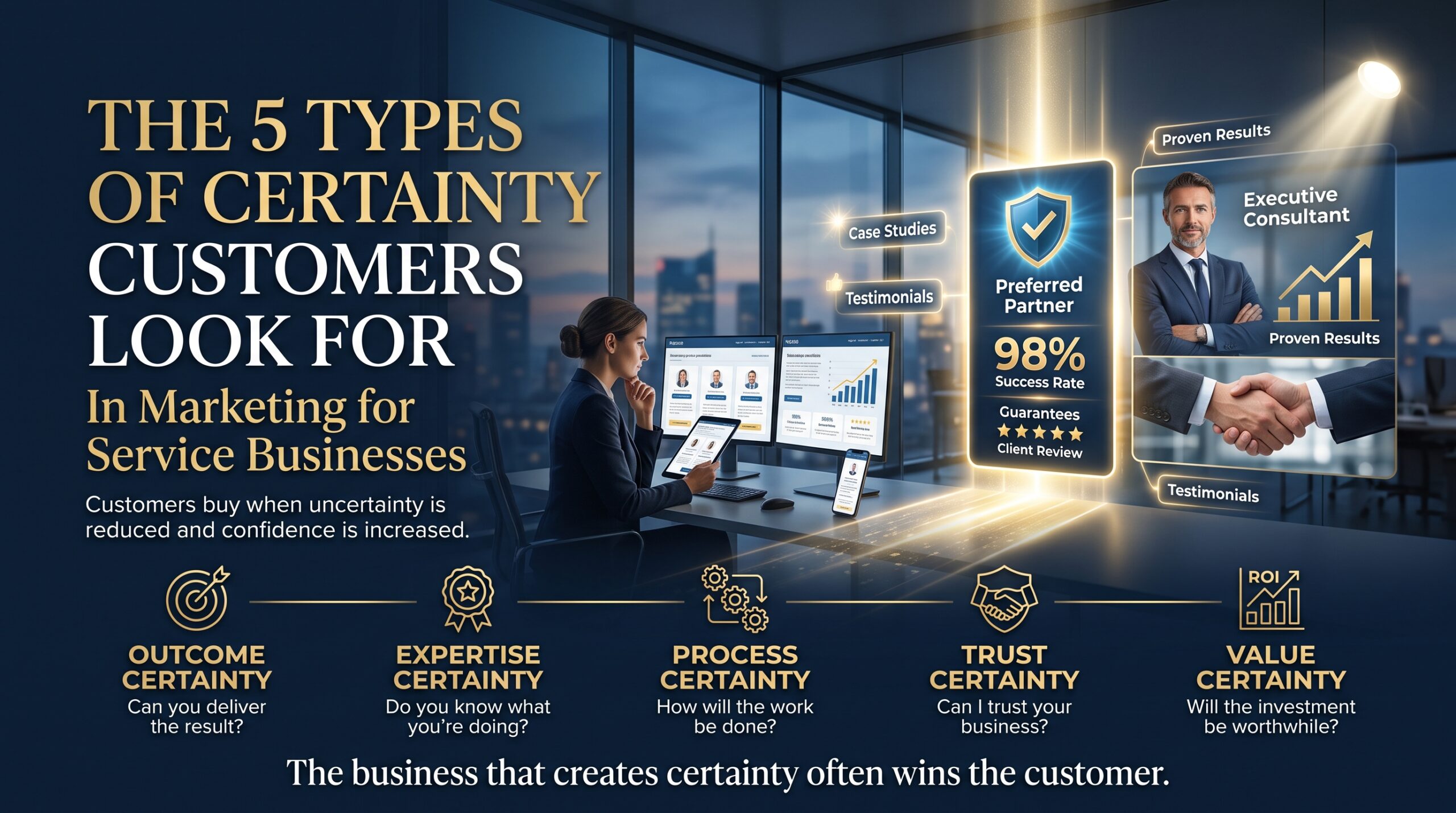
1. Certainty of outcome
Be specific about what changes for the customer. “We help businesses grow” is vague. “We help local trades businesses get more quote requests from Google” is something a buyer can picture. Describe the result in their words, not yours.
2. Certainty of price
Hidden pricing makes people assume the worst. You don’t need to publish every figure, but ranges, starting points or clear packages calm nerves quickly. Pages such as SEO packages and Google Ads packages show the idea: a buyer can see what they’re getting before they pick up the phone.
3. Certainty of process
People relax when they can see the steps. Spell out what happens after an enquiry, how long each stage takes and what you’ll need from them. A simple four-step graphic often does more than three paragraphs of copy.
4. Certainty of proof
Reviews, case studies, before-and-after examples and recognisable client logos let buyers borrow other people’s experience. Named, specific proof beats general praise every time. Only use results you can back up, and always get permission.
5. Certainty of support
Buyers want to know somebody will pick up if something goes wrong. Show real contact details, reporting rhythms, response times and what happens if a result is missed. Transparent reporting is a trust signal in its own right.
Where Customers Look for Certainty Online
Customers rarely look in one place. They check Google, then your reviews, then your website, then maybe your social feed, before they ever call. In marketing for service businesses, each channel is a chance to supply a different piece of certainty:
- Search results: Showing up for the problem someone is searching signals you’re a real option. Good SEO services help the right people find you first.
- Paid search: Ads that match the search and promise something specific tell buyers they’re in the right place. See how Google Ads management can capture people who are ready to act.
- Your website: It’s the central proof point. A clear offer, visible reviews and an easy enquiry path matter more than clever animation. Website design and SEO ties both together.
- Social media: Consistent, helpful posts show there’s a real business behind the logo. Social media marketing keeps that evidence fresh.
- Email and content: Follow-ups and useful guides keep you familiar while people decide. Explore email marketing and content marketing for ongoing reassurance.
The most effective marketing for service businesses connects these touchpoints so a customer sees the same promise, the same proof and the same tone everywhere they look. You can browse the full range of digital marketing services to see how they fit together.
A 90-Day Plan for Marketing for Service Businesses That Builds Certainty
You don’t need a bigger budget to improve your marketing for service businesses. You need a clearer message. Try this:
- Weeks 1–2: Write your outcome statement. Finish this sentence in plain English: “We help [type of customer] get [specific result] without [biggest fear].”
- Weeks 1–2: Audit your doubts. List the five questions prospects ask most often on calls and put the answers on your website.
- Weeks 3–4: Show your price logic. Add a starting price, package outline or “what affects the cost” section.
- Weeks 5–6: Collect proof. Ask your five happiest customers for a named review and one short case study.
- Weeks 7–8: Draw the process. Create a simple three- or four-step graphic and place it on your homepage and service pages.
- Weeks 9–12: Align your channels. Make sure your ads, landing pages, Google Business Profile and social posts all repeat the same promise and proof.
Local Marketing for Service Businesses Across Australian Cities
Local certainty is a powerful part of marketing for service businesses. A Perth plumber, a Brisbane dentist and a Canberra consultant all benefit from showing local suburbs, local reviews and a real address. Our location pages cover Sydney, Melbourne, Brisbane, Perth, Adelaide or Canberra, and the full list is on the locations page. We also work with businesses in the Gold Coast, Hobart, Darwin, Newcastle, Geelong and other regions.
Keep your Google Business Profile complete and current, since it’s often the first impression a local customer gets. Google’s own SEO starter guide is a solid free reference, and the ACCC advertising and selling guide explains how to keep claims honest, which is itself a form of trust. The Australian Small Business and Family Enterprise Ombudsman also publishes helpful resources for owners.
If you’d rather build the skills in-house, a structured digital marketing course can help your team understand how the channels work. And if you’d prefer to hand it over, compare our marketing packages to see what fits your budget.
Marketing for Service Businesses FAQs
What is marketing for service businesses?
It’s the set of strategies used to attract and convince customers who are buying something intangible, such as advice, repairs, treatment or professional work. Because the result can’t be inspected beforehand, it focuses heavily on trust, proof and clarity.
Why do customers need certainty before buying a service?
Because they pay first and judge the result later. Certainty about outcome, price, process, proof and support reduces the perceived risk of that gap.
Do I need both SEO and Google Ads?
Many service businesses use both. Ads can bring quick enquiries while SEO builds longer-term visibility. The right mix depends on your market, budget and goals, so a short consultation helps.
How long does it take to see results?
Paid campaigns can generate enquiries soon after launch, while organic search usually takes longer. Clearer messaging and stronger proof can lift response from the traffic you already have.
How much does it cost?
It varies by channel and scope. Review the packages and pricing or contact us for a tailored recommendation. You can also read the FAQs page.
Final Thoughts: Sell Certainty and the Service Sells Itself
The best provider doesn’t always win. The provider who feels safest does. Marketing for service businesses works when it answers the silent questions a buyer is asking, and it keeps working when every channel tells the same clear, honest story.
Pick one type of certainty from this article and strengthen it this week. If you’d like help, book a free consultation or call 1300 649 299. You can also read more about us or browse the blog for more marketing ideas.