


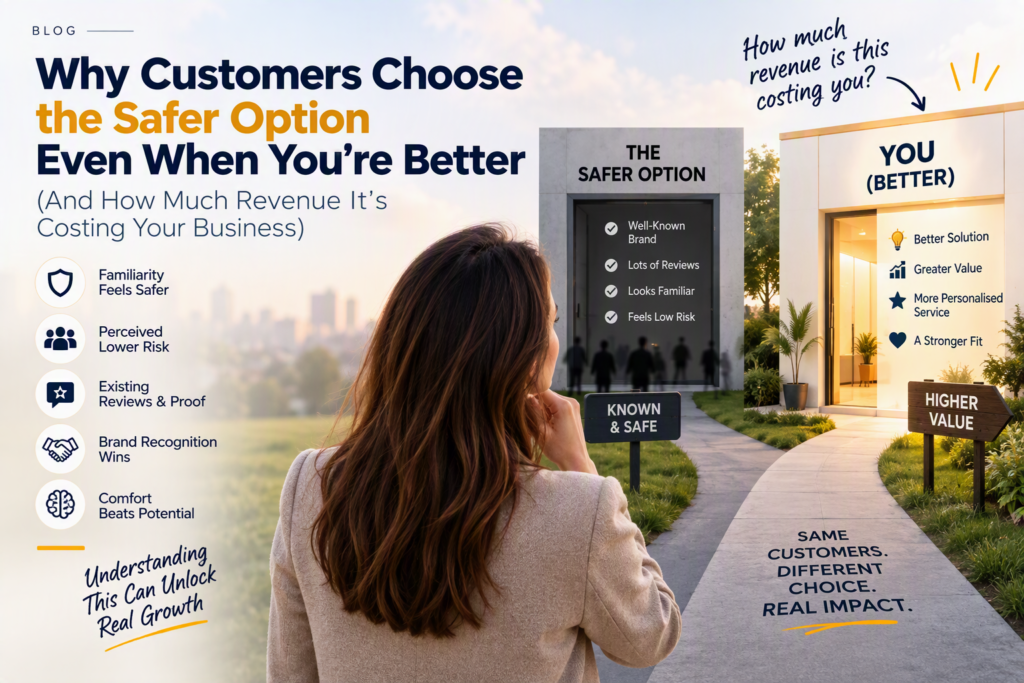
Why customers choose the safer option is one of the most expensive blind spots in Australian business today. You built the better product. Faster onboarding, better support, stronger results, sharper pricing and the prospect still signed with the bigger, slower, more expensive competitor down the road. It isn’t bad luck, and it isn’t your sales pitch. It’s a documented decision-making pattern called safe-choice bias, and understanding it is the difference between watching revenue leak away and building an offer buyers can’t walk past.
What Is Safe-Choice Bias, and Why Does It Beat a Better Product?
Safe-choice bias (also called status quo bias or risk-averse purchasing) is the tendency for buyers to pick the option that feels lowest-risk not the option that performs best. It shows up everywhere from software procurement to choosing a marketing agency, and it explains a phrase every salesperson has heard in some form: nobody gets fired for buying the market leader.
When a buyer is deciding between you and a bigger, more established competitor, they aren’t only comparing features. They’re comparing perceived downside if the decision goes wrong. A well-known brand offers social cover; a newer or smaller provider even a demonstrably better one carries personal career risk for the person signing the contract.
This is why understanding why customers choose the safer option matters more for growth than almost any other conversion lever you have. You can out-perform a competitor on every measurable dimension and still lose the deal, because the buyer isn’t optimising for outcome they’re optimising for blame avoidance.
The Psychology Behind the Safer Choice
Four well-documented behavioural patterns combine to produce this effect:
- Loss aversion the pain of a bad decision is felt roughly twice as strongly as the pleasure of a good one, so buyers over-weight downside risk.
- Social proof and herd mentality “everyone else uses them” substitutes for independent evaluation.
- Decision fatigue the more options and the more complex the buying committee, the more buyers default to the familiar name to end the process.
- Reversibility bias buyers unconsciously ask, “if this fails, can I say I chose the obvious option?” rather than “is this the best option?”
Harvard Business Review on organisational risk aversion and usability findings from Nielsen Norman Group on decision paralysis both point to the same root cause: perceived risk, not product quality, is usually the deciding variable in B2B purchases.
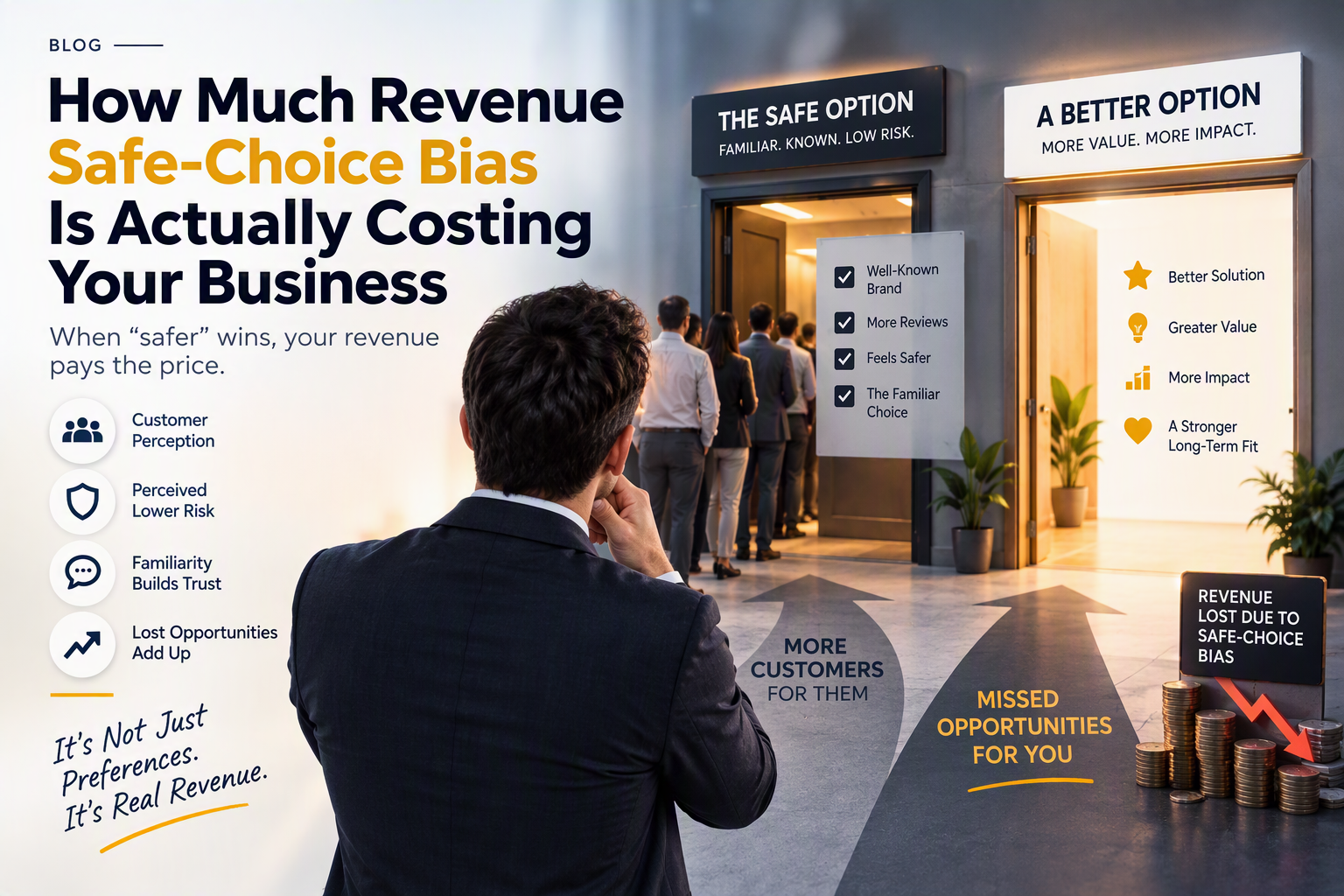
How Much Revenue Safe-Choice Bias Is Actually Costing Your Business
This isn’t an abstract psychology problem it’s a line item. Based on typical B2B and service-business conversion benchmarks across Australian markets, here’s where the leakage tends to concentrate:
| Stage Lost To | Typical Revenue Impact | Root Cause |
| Shortlist stage | 20–35% of qualified leads | Buyer defaults to the recognisable name before evaluating your proposal |
| Final 2 (you vs. incumbent-style brand) | 40–60% of remaining deals | No risk-reversal offer to counter “safer” competitor |
| Post-decision reversal | 5–10% of signed deals | Buyer gets internal pushback and reverts to the safer name |
| Referral / repeat business | 15–25% lost long-term value | Buyer avoids recommending the “riskier” choice to peers, even when satisfied |
Multiply even the low end of these ranges across a year of pipeline, and safe-choice bias is frequently the single largest uncaptured revenue category in a growing business larger than most paid-media inefficiencies combined.
City-by-City: Where Australian Buyers Are Most Risk-Averse
Risk tolerance in B2B buying isn’t uniform across Australia. Buying-committee size, industry mix and market maturity all shift how strongly safe-choice bias shows up:
| City | Buyer Risk Profile | What Wins Deals Locally |
| Sydney | High large corporate buying committees, finance and enterprise-heavy | Case studies, references from recognisable Sydney brands, formal guarantees |
| Melbourne | High process-driven procurement, agency and professional-services heavy | Documented process, credentials, clear SLAs |
| Brisbane | Moderate faster decision cycles, more owner-operator buyers | Direct relationship-building and fast proof points |
| Perth | Moderate-high resources/mining sector caution, smaller supplier pools | Local presence and long-tenure signals |
| Adelaide | Moderate smaller market, closer referral networks | Word-of-mouth and local reputation |
| Canberra | Very high government/public-sector procurement culture | Compliance credentials, panel status, low-risk framing |
Signs Your Better Product Is Losing to a “Safer” Competitor
- You consistently make the final shortlist but lose to the same 1–2 competitors
- Prospects say “you’re exactly what we need” and still don’t sign
- Deals stall after a champion inside the buying company loses internal support
- Your win rate is strong with founders/owners but weak with committees or procurement teams
- Competitors with worse reviews or slower delivery still out-sell you on brand recognition alone
7 Proven Strategies to Break the Safe-Choice Cycle
Beating safe-choice bias isn’t about being louder it’s about re-engineering perceived risk. These are the levers that consistently move the decision back toward the better option:
1. Make the Risk of Switching Smaller Than the Risk of Staying
Pilot periods, phased onboarding, money-back milestones and “cancel anytime” terms directly counter loss aversion by capping the buyer’s downside.
2. Borrow Credibility Instead of Asking for Trust
Case studies from recognisable local names, third-party certifications, and visible client logos substitute for the social proof a bigger competitor gets for free.
- Reduce the number of decision-makers required. Simplify your proposal so a single champion can approve it without escalating to a full committee every extra approver adds decision fatigue and pulls the outcome toward the familiar name.
- Reframe “new” as “specialist.” Buyers fear generic unknowns, not specialists. Position your business as the focused expert choice rather than the alternative to the big name.
- Publish a clear guarantee. A written performance guarantee is one of the fastest ways to flip the safe-choice calculation, because it moves the risk from the buyer back onto you.
- Give the buyer a script to defend the decision internally. Most “safe” choices aren’t personal preference they’re what the buyer can defend to their boss. Hand them the one-pager that does that job for you.
- Fix the marketing, not just the sales pitch. If your SEO, ads and website don’t build category authority before the sales conversation even starts, you’re asking your sales team to overcome safe-choice bias with no reinforcement. This is where an experienced marketing partner changes the outcome.
How a Digital Marketing Agency Fixes This For You
The strategies above only work if your brand shows up as the obviously credible choice before a prospect ever gets on a call. That means SEO, Google Ads and conversion-focused content working together to build authority ahead of the sale not just traffic. digitalmarketingagencies.au builds exactly this kind of category-authority marketing for Australian businesses, and our Brisbane digital marketing team applies the same playbook locally for Queensland businesses competing against bigger, more “established” names.
If your team wants to build these skills in-house, Logitrain runs Australian-delivered digital marketing, SEO and Google Ads training courses that cover exactly this kind of conversion psychology and campaign structure.
Frequently Asked Questions
Why do customers choose the safer option even when a competitor is better?
Because buyers are weighing perceived personal and organisational risk, not just product quality. Loss aversion makes a bad outcome feel far more costly than a good outcome feels rewarding, so the familiar or bigger name wins by default.
How do I know if safe-choice bias is costing me revenue?
If you regularly reach the final shortlist and lose to the same larger competitors, or prospects praise your offer without signing, safe-choice bias is very likely the deciding factor rather than price or features.
What’s the fastest fix for safe-choice bias?
A written guarantee or low-risk pilot period, paired with case studies from recognisable local clients, produces the fastest measurable shift in win rate.
Does this affect small businesses more than large ones?
Yes smaller and newer businesses are judged as higher-risk by default, regardless of quality, which makes deliberate risk-reversal and authority-building even more important.
Final Word
Understanding why customers choose the safer option reframes the problem from “our sales pitch isn’t working” to “our buyer’s risk calculation isn’t working in our favour.” Fix the risk calculation through guarantees, proof, positioning and marketing that builds authority ahead of the sale and the better product starts winning the deals it deserves.