
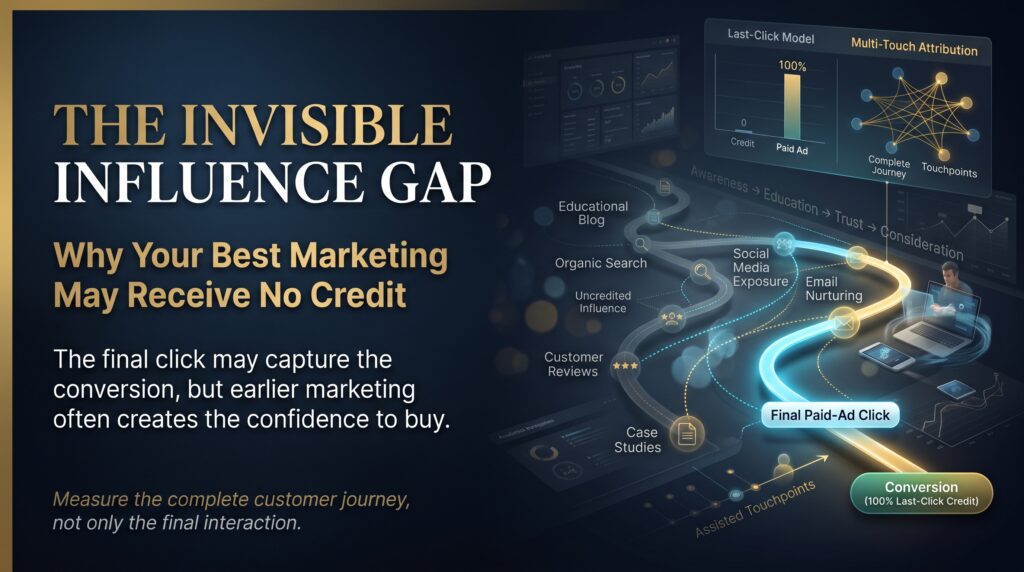


The invisible influence gap is the distance between the marketing that actually persuades people and the marketing your reports give credit to. It is why a campaign can look like a flop on paper while quietly feeding your pipeline, and why a tidy little brand ad can look like a hero when it only collected what others earned.
If you have ever stared at a dashboard and thought, “this does not match what customers tell us,” you have met it. This guide explains how the invisible influence gap forms, how to spot it in your own numbers, and what to do before it pushes you into cutting the wrong channel.
What Is the Invisible Influence Gap?
Customers rarely decide in a straight line. They hear a name from a neighbour, see a post, read an article on their phone, forget about it, then search for you a week later. Marketing attribution tries to trace that path. The trouble is that most of the path never leaves a trace.
The invisible influence gap shows up in three ways:
- Untracked touches. Word of mouth, group chats, podcasts, print and in-person recommendations leave no click behind.
- Misplaced credit. Reports hand the win to the last thing someone clicked, not the first thing that convinced them.
- Influence without visits. People see your brand in search results, social feeds or an AI answer and never visit your site at all.
Why Your Best Marketing May Receive No Credit
None of this means your analytics are broken. They are doing exactly what they were built to do, which is count what can be counted. Here is where the invisible influence gap usually opens up.
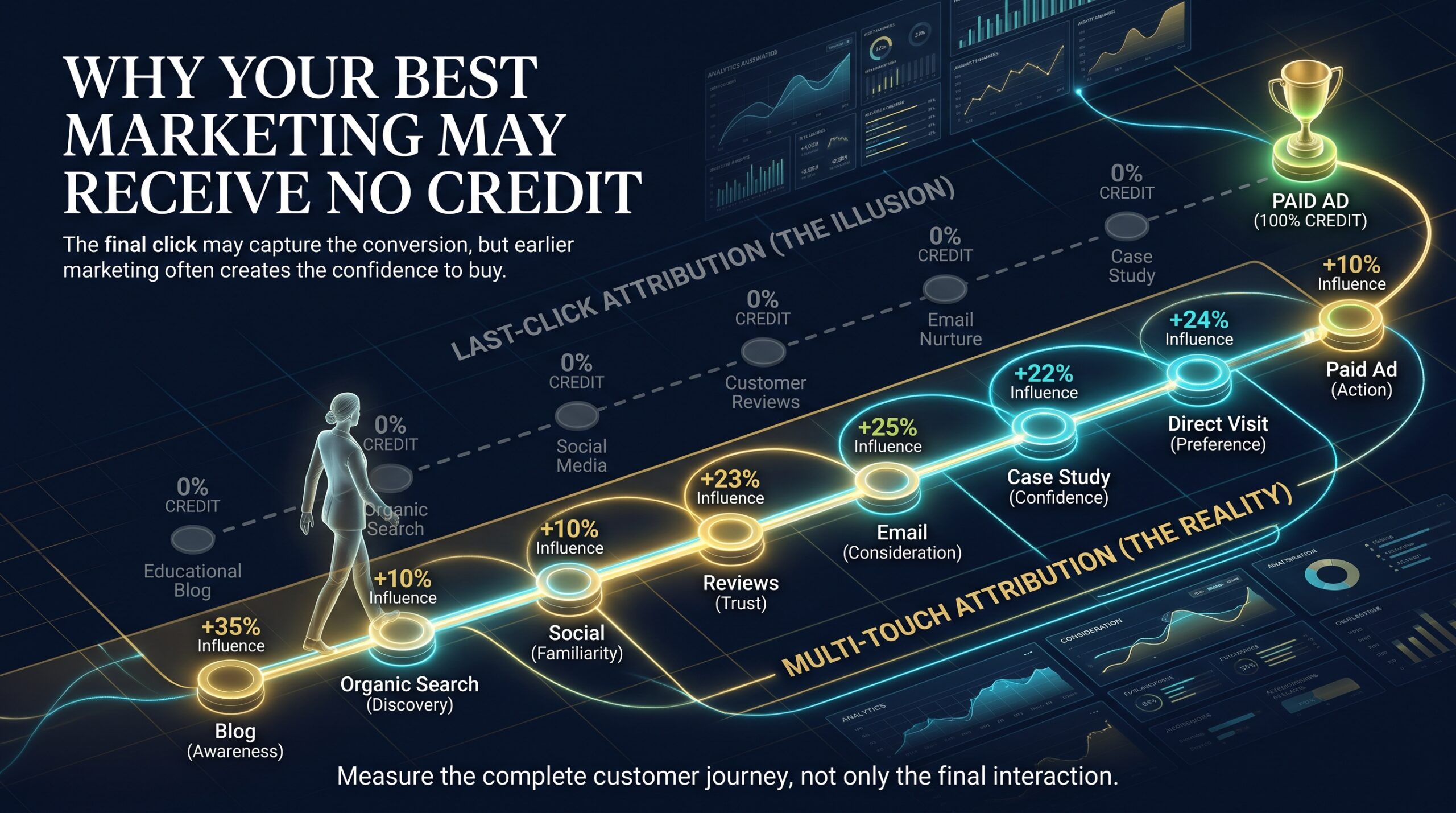
Last-click reporting rewards the final step
Look at the attribution options in Google Analytics 4 and you will find a short menu. The attribution reports offer data-driven, paid and organic last click, and Google paid channels last click. Older rules-based options such as first click and linear were retired in late 2023. Every one of those models only sees tracked interactions. The conversation in a group chat is not one of them, so the invisible influence gap sits outside the model by design.
Dark social swallows word of mouth
When someone shares your guide through a private message, an email or a messaging app, the visit often arrives with no source attached. Your report files it as direct traffic. That label makes it look like nobody can say where it came from, when in fact a real person recommended you.
Brand search takes the bow
People who already know your name search for it. Whoever owns that final click, usually a brand ad or organic result, collects the credit. The ad did not create the intent. Your content, reviews and reputation did. Treat strong brand search numbers as a symptom of earlier work, not proof that brand ads are your best channel.
Offline and local influence
A flyer, a local sponsorship, a trade show chat or a print advertising placement can all start a journey that ends on Google. Phone calls and map directions may never be matched to the original touch, so the invisible influence gap is usually widest for local service businesses.
Zero-click and AI answers
More of the answer now appears on the results page itself. Someone can read your brand’s name in a summary, a map listing or a social preview and form an opinion without a single session being recorded. That is influence with no data trail.
Privacy limits and missing devices
Consent choices, browser restrictions and people switching between phone and laptop mean parts of the journey are never joined up. Reasonable privacy rules shrink the visible slice further, which makes the invisible influence gap bigger over time.
A Simple Example of the Invisible Influence Gap
Here is a hypothetical scenario. A home renovation business in Perth publishes helpful planning guides and shares tips in local community groups. A homeowner reads one in a group chat, does not click anything, and moves on.
Ten days later she searches the business name and clicks a brand ad. She calls. The report credits the brand ad with the sale and shows a superb return. Meanwhile the content that did the persuading shows almost nothing.
Looking at that report, the owner trims the content budget and doubles down on brand ads. Three months later, brand searches slip and enquiries follow them. The data did not lie. It just could not see the invisible influence gap.
Signs You Have an Invisible Influence Gap
- Direct traffic and brand search keep growing, but your non-brand traffic is flat.
- Customers say a friend or a post introduced them, while the CRM says “Google”.
- A channel looked weak in reports, yet results dipped after you paused it.
- Platform dashboards show strong returns, but overall revenue barely moves.
- Your sales team and your marketing team tell different stories about where leads come from.
How to Measure the Invisible Influence Gap
You cannot track everything, but you can measure around the edges. These steps shrink the invisible influence gap without a huge budget:
- Ask people directly. Add a “How did you hear about us?” field to forms and ask on calls. Free-text answers are messy but honest, and they surface the channels your tools cannot see.
- Watch brand search over time. Track branded queries in Google Search Console and Google Trends. A steady rise after a campaign is a clue that something upstream is working.
- Use clean tracking where you can. Apply consistent UTM tags, vanity URLs, promo codes and call tracking numbers so offline and social efforts can leave a mark.
- Run holdout tests. Pause a channel in one region, or one city, and compare against a similar region. This kind of incrementality test asks what happens without the channel, not what the report claims it did.
- Compare models, not just numbers. Use the model comparison view in Google Analytics 4 to see how credit moves between data-driven and last-click views.
- Consider marketing mix modelling. For larger budgets, a statistical approach such as Google’s open-source Meridian estimates each channel’s contribution without relying on individual click paths.
- Report on blended results. Divide total revenue by total marketing spend. It is crude, but it is hard to game and it cannot be fooled by who clicked last.
Marketing efficiency ratio = total revenue / total marketing spend
How to Close the Invisible Influence Gap
Measuring is half the job. The other half is changing how you decide:
- Protect upstream work. Keep funding the content, search and social activity that builds the audience for your brand searches, even when last-click numbers look modest.
- Set budgets with more than one lens. Blend platform data, customer answers, holdout tests and total revenue before moving money.
- Track leading indicators. Branded search, direct visits, saves, shares and returning visitors tell you early whether awareness is growing.
- Align sales and marketing. Agree on how leads are labelled so the CRM captures what customers actually say.
- Review on a longer rhythm. Judge brand-building work over quarters, not days.
The Invisible Influence Gap by Channel
Every channel has its own blind spot. Use this quick guide when you review your mix:
| Channel | What reports usually show | What may be hidden |
| SEO | Organic sessions and a few conversions | Readers who return later via brand search or a direct visit |
| Google Ads | Strong returns on brand campaigns | Earlier content and word of mouth that created the search |
| Social media | Low click-through and few conversions | Shares, saves and recommendations in private chats |
| Content marketing | Modest traffic per article | Trust built before someone ever searches for you |
| Email marketing | Opens and last-click sales | Forwarded messages and later direct visits |
| Print advertising | Almost nothing | Calls, walk-ins and searches that start offline |
Marketing Support Across Australia
Digital Marketing Agencies helps Australian businesses see their whole customer journey, not only the last click. Our digital marketing services cover SEO, Google advertising, social media, content marketing, website design and SEO, email marketing, digital advertising and eCommerce marketing. Prefer clear pricing? Browse our marketing packages, including SEO packages, Google Ads packages, social media packages and content marketing packages.
Find a team near you:
- Digital marketing agency in Melbourne
- Digital marketing agency in Sydney
- Digital marketing agency in Brisbane
- Digital marketing agency in Perth
- Digital marketing agency in Adelaide
- Digital marketing agency in Canberra
We also support businesses in the Gold Coast, Hobart, Darwin, Newcastle, Wollongong, Geelong, Sunshine Coast, Townsville, Cairns and surrounding regions. See all locations, learn about us, or call 1300 649 299.
Invisible Influence Gap FAQs
What is the invisible influence gap in marketing?
The invisible influence gap is the difference between what really influences a customer and what your reports credit. It comes from untracked touches, last-click bias and influence that happens without a website visit.
Why is my direct traffic increasing?
Direct traffic often includes dark social, such as links shared in messages and emails, along with people typing your address after hearing about you elsewhere. It is worth cross-checking with customer answers.
Which attribution model is best?
No single model is complete. Data-driven and last-click views show different slices of tracked activity, so pair them with customer feedback, holdout tests and blended revenue.
How can a small business reduce the invisible influence gap?
Start cheap. Ask customers how they found you, use unique phone numbers and promo codes, watch branded search, and compare results when you pause a channel. Our FAQs page answers more common questions.
Final Thoughts
The best marketing often works quietly. It builds trust, plants a name and waits. The invisible influence gap is the price of that quiet effect, and ignoring it leads to cutting the work that makes everything else perform. Measure what you can, respect what you cannot, and decide with more than one lens. Want help building a clearer picture? Contact our team and we will look at your numbers with you, or read more on our blog.